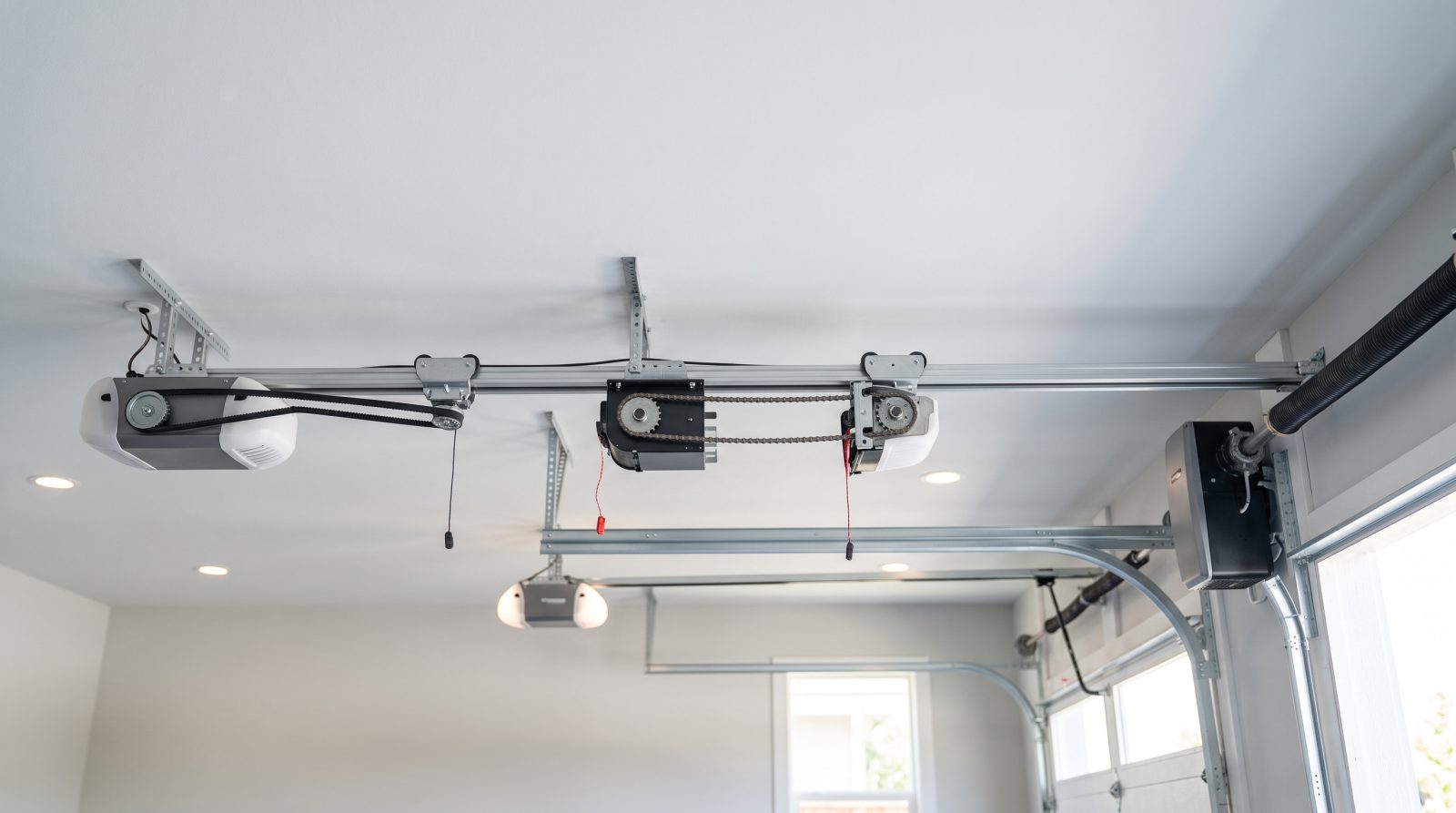
Drive Types: Belt vs. Chain vs. Screw vs. Direct Drive
The drive system is the single biggest decision you'll make, because it determines how your opener sounds, how often it needs attention, and how long it lasts. The drive is simply the mechanism that pulls the trolley along the rail to raise and lower the door. There are four common types, and each has a clear best-fit situation. Once you understand the trade-offs, the rest of the buying process gets a lot easier.
Belt drive openers use a reinforced rubber belt and are the quietest option by a wide margin. If your garage shares a wall or ceiling with a bedroom, home office, or a bonus room above, which is extremely common in newer Natomas, Elk Grove, and Roseville two-story builds, a belt drive is almost always the right call. They have fewer vibrations, less metal-on-metal noise, and they hold up well in our dry heat. Chain drive openers use a metal chain, cost less up front, and are extremely durable, but they're noticeably louder. For a detached garage or a single-story home where the garage isn't under living space, a chain drive is a perfectly sensible, budget-friendly choice.
Screw drive openers use a threaded steel rod and have fewer moving parts, which can mean less routine maintenance. The catch is that older screw-drive designs were sensitive to temperature swings, and Sacramento garages routinely swing from cold winter mornings to attic-like summer afternoons well over 100 degrees. Modern screw drives handle this far better than older units, but it's worth knowing the history. Direct drive (sometimes called jackshaft or wall-mount) openers either move the motor itself along the rail or mount on the wall beside the door, freeing up ceiling space entirely. Wall-mount units are excellent for garages with high, vaulted, or low-clearance ceilings and tend to be very quiet and reliable.
- Belt drive: quietest, best for garages under or beside living space; ideal for two-story Sacramento-area homes
- Chain drive: most affordable and very durable, but louder; great for detached or single-story garages
- Screw drive: fewer moving parts and low maintenance; modern units tolerate our heat far better than older ones
- Direct/wall-mount: frees ceiling space, very quiet; best for low-clearance, high-ceiling, or storage-heavy garages
How Much Horsepower Do You Actually Need?
Horsepower (HP) is the most over-thought number in the opener aisle. The rating describes the motor's lifting power, and bigger is not automatically better, it's about matching the motor to the weight of your door. Buying far more power than you need wastes money and doesn't make the door open faster or last longer. The goal is a motor that lifts your specific door comfortably without straining.
The biggest factor is door material and size. A single-car, lightweight aluminum or thin steel door asks very little of the motor. A standard double-wide insulated steel door, the most common setup in Sacramento suburban garages, needs more. The heavyweights are solid wood and premium insulated doors with thick R-value cores, which a lot of homeowners install here specifically to keep the garage cooler in summer. The heavier and better-insulated your door, the more lifting power you want so the motor isn't working at its limit every cycle.
Many modern openers are now rated in newtons of force or in motor-equivalent terms rather than traditional fractional HP, especially DC-motor models. DC motors also bring soft-start and soft-stop, meaning the door eases into motion and slows before it lands instead of slamming. That's gentler on the door, the hardware, and your ears, and it's one of the bigger real-world upgrades over older AC-motor units. If you're unsure what your door weighs or how it's built, this is exactly the kind of thing we can assess on-site, since the right answer depends on your actual door, not a generic chart.
- 1/2 HP (or DC equivalent): fine for most single, lightweight, or non-insulated doors
- 3/4 HP (or DC equivalent): the practical sweet spot for standard double insulated steel doors
- 1 HP+ (or higher-force DC): best for heavy solid-wood doors and thick high-R-value insulated doors common in heat-conscious Sacramento homes
- Prefer a DC motor with soft-start/soft-stop for quieter, smoother, longer-lasting operation
Smart Features and Security Worth Paying For
Today's openers are as much a connected device as a motor, and a few of these features genuinely change daily life, while others are nice-to-have. The trick is knowing which is which before you pay for them. Start with the features that affect safety and security, then add convenience on top.
Wi-Fi connectivity with a smartphone app is the headline feature, and it's more useful than it sounds. You can confirm the door is closed from the office downtown, get an alert if it's been left open during a Sacramento summer afternoon (a real security and heat concern), and grant temporary access to a house cleaner or dog walker without handing out a physical remote. Battery backup is arguably the most underrated feature in our area: when PG&E power goes out, whether from a winter storm or a summer grid event, a battery backup lets you still get your car out without manually disconnecting the door. In California, battery backup is required on new opener installations, so this is the standard now rather than an upsell.
On the security side, rolling-code technology, where the opener and remote generate a new code every use, is now standard and protects against code-grabbing. MyQ, HomeLink, and similar ecosystems let you tie the opener into smart-home setups and newer vehicles. Don't overlook the basics, either: a wall-mounted control panel with a timer-to-close, a manual lock, and good integrated LED lighting make the garage safer and more pleasant to use every single day. Spend on the safety and reliability features first; the convenience extras are easier to justify once the fundamentals are covered.
- Battery backup: required on new California installs and invaluable during PG&E outages, your door still works when the power doesn't
- Wi-Fi + app: remote open/close, left-open alerts, and temporary access for guests or service providers
- Rolling-code security: a fresh code every cycle to defeat remote-grabbing devices (now standard)
- Smart-home tie-ins (MyQ, HomeLink): integrate with vehicles and home automation
- Quality-of-life: timer-to-close, bright integrated LED lighting, and a manual lock for when you're away
Choosing for the Sacramento Climate and Home
Sacramento's climate puts real, specific demands on a garage door opener, and ignoring them is how people end up replacing an opener years too early. Our summers are long and genuinely hot, with stretches of triple-digit days, while winters bring cool, damp mornings and occasional Tule fog. An opener's electronics and lubrication live through all of it, often in an uninsulated or partially insulated space that gets hotter than the outdoor air. That thermal cycling is the environmental factor that matters most here.
Heat is the quiet killer. Garages without insulation or a conditioned wall can soar well past the outdoor temperature on a July afternoon, and that heat is hard on circuit boards, plastic gears, and grease that thins out and migrates. This is a strong argument for choosing a reputable opener with quality electronics and for pairing a new opener with a well-balanced, properly lubricated door so the motor isn't fighting friction in the heat. If you've added an insulated door to keep your garage cooler, remember it's heavier, plan your horsepower accordingly. Dust and fine valley pollen also accumulate on sensors and tracks, so the photo-eye safety sensors near the floor occasionally need a wipe to keep the door from reversing for no reason.
Home style matters too. Sacramento's housing runs from older bungalows and ranch homes in Land Park, Curtis Park, and East Sac to sprawling newer subdivisions in Elk Grove, Roseville, Folsom, and Natomas. Older homes sometimes have tight ceiling clearance or unusual framing where a wall-mount opener shines, while newer two-story homes with bedrooms over the garage almost beg for a quiet belt drive. Because we're a mobile operation, we see all of these layouts across the region, and the best opener is genuinely the one that fits your house, your door, and how your garage is built, not just the one on sale.
- Plan for heat: choose quality electronics and keep the door balanced and lubricated so the motor isn't straining in summer
- Heavier insulated doors (popular for cooler garages here) need more lifting power, size up your HP/force
- Keep floor-level photo-eye sensors clean of valley dust and pollen to prevent nuisance reversals
- Match the opener to your home: belt drive for bedrooms-over-garage; wall-mount for tight or high ceilings in older homes
Installation, Service, and Knowing When to Replace
A great opener can still disappoint if it's poorly installed or paired with a worn-out door, so it pays to think of the opener as one part of a system. The opener lifts the door, but the springs do most of the heavy work. If your torsion or extension springs are tired, the opener compensates by working harder, runs hotter, and wears out faster. Any honest opener decision starts with making sure the door itself is balanced and the springs are healthy.
There are clear signs it's time to replace rather than repair an opener. If your unit is fifteen or more years old, it likely lacks rolling-code security, battery backup, and the quiet smoothness of a modern DC motor, and replacement parts get scarce. Frequent reversing, grinding or straining noises, slow or jerky travel, or an opener that simply can't be paired with newer remotes or your phone are all signals you're better off upgrading than patching. A new opener with modern safety and security features is often a smart move even when the old one technically still runs.
Because we come to you, the buying decision and the installation can happen in the same visit, on your actual door, in your actual garage, with the clearances and quirks of your home accounted for. We can assess your door's balance and spring condition, recommend a drive type and power level suited to your home, and handle disposal of the old unit. Whether you already know what you want or just know your opener is on its last legs, you can call or request a free quote and we'll help you choose the right opener for your Sacramento home, no storefront trip required.
- Check the springs first, a tired spring makes any opener work too hard and fail early
- Strong replace signals: 15+ years old, frequent reversing, grinding/straining, slow travel, no smart/remote compatibility
- Modern upgrades (rolling code, battery backup, DC soft-start) often justify replacement even if the old unit still runs
- Mobile service means assessment and install on your real door in one visit, call or request a free quote