The Two Spring Families: Torsion vs. Extension
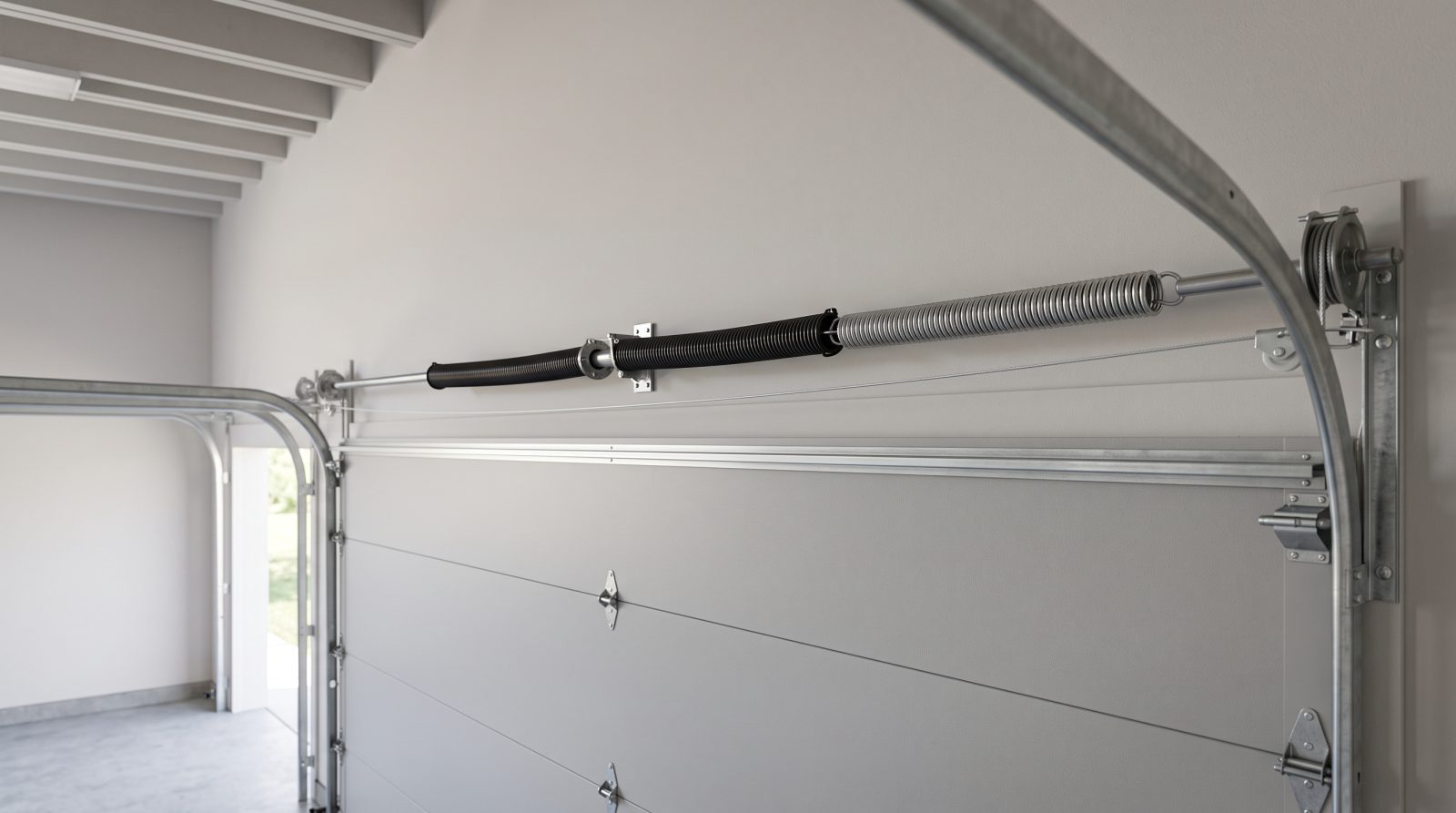
Every residential garage door uses one of two counterbalance systems, and you can usually tell which you have in about ten seconds. Torsion springs mount horizontally on a metal shaft above the door opening, parallel to the top of the door. When the door moves, the spring winds and unwinds, storing and releasing torque through cables wound onto drums at each end of the shaft. Extension springs run perpendicular, stretched along the horizontal tracks on the left and right above where your car parks. They store energy by stretching and contracting as the door opens and closes.
The difference is more than placement. Torsion is the newer, more controlled system: the door rises evenly, sits more stable in any partly-open position, and the spring is captured on a shaft so it can't fly across the garage if it breaks. Extension springs are the older, simpler design still common on single-car doors and many homes built before the 2000s throughout older Sacramento neighborhoods like Tahoe Park, Oak Park, and parts of Carmichael. They are less expensive to manufacture but more exposed, which is why a properly installed extension system always includes a safety containment cable threaded through the spring.
If you're not sure which you have, look above the door from inside the garage with the door closed. A single (or double) spring on a bar across the top means torsion. Long springs running back along the ceiling tracks on each side mean extension.
How Each Spring Actually Works (and Why It Matters)
Understanding the mechanics helps you understand why one type may suit your door better. A torsion spring works by twisting. As the door closes, the cables pull the spring tight, winding stored energy into the coil. When you open the door, that torque unwinds and lifts the weight smoothly. Because the force is applied through a central shaft and balanced drums, torsion systems lift heavier doors with better control and put less strain on your opener.
Extension springs work by stretching. They're under tension at rest when the door is closed, and they contract as the door opens, pulling the door up via a system of pulleys and cables. Because each side operates somewhat independently, an extension door can rack or hang slightly crooked if one spring weakens before the other. They also store energy in a way that, without a safety cable, can send a broken spring whipping across the garage.
- Torsion springs: mounted on a shaft above the door, twist to store energy, lift evenly, last longer per cycle, better for heavy and double doors
- Extension springs: mounted along the side tracks, stretch to store energy, lower upfront cost, common on lighter single doors, require a safety containment cable
- Cycle rating is the key spec: one cycle equals one full open and close. Standard springs are often rated around 10,000 cycles; high-cycle options run higher
- A two-car household opening the door 4 to 6 times a day can burn through a standard-rated spring faster than the math suggests, especially with our temperature swings
Lifespan, Sacramento Climate, and What Wears Springs Out
Springs are rated in cycles, not years, but real-world Sacramento conditions push them toward the lower end of their rating. Our long, hot Central Valley summers and cooler Delta-breeze nights create daily expansion and contraction in the metal. Steel fatigues a little more with every heat cycle, and a spring sitting in a west-facing garage in Roseville or Rancho Cordova takes more thermal abuse than the spec sheet assumes.
Rust is the other quiet killer. While Sacramento is drier than coastal areas, winter Tule fog, sprinkler overspray, and humidity in attached garages still leave moisture on coils. Rust adds friction between the coils, accelerating wear and sometimes causing premature snapping. A light annual lubrication with a garage-door-specific lubricant slows this down considerably.
As a rough guide, a standard spring opened a few times a day may last several years, while a high-cycle spring on the same door can last meaningfully longer. The honest answer is that lifespan depends on cycle count, spring quality, balance, and maintenance, so any specific year figure is an estimate, not a promise. The most reliable signal isn't the calendar, it's behavior: a door that's gotten heavy, jerky, or noisy is telling you the spring is near the end.
- A 2 to 3 inch gap in a torsion spring coil is the classic sign it has snapped
- A door that slams shut, won't stay open halfway, or feels extremely heavy by hand points to a failed or weak spring
- Grinding, popping, or the opener straining and reversing often traces back to spring imbalance
- One spring on a two-spring door breaking means the other is usually near failure too, replacing in pairs avoids a second service trip
Safety: Why Spring Work Is the One DIY Job to Skip
Garage door springs hold an enormous amount of stored energy, and that is not a marketing line, it's physics. A torsion spring under full tension can release that energy in a fraction of a second. Winding bars that slip, a cable that's installed under load incorrectly, or a spring that lets go during adjustment can cause serious injuries. This is the part of garage door repair where the gap between a professional and a confident homeowner with a video tutorial is the widest.
Extension springs carry their own hazard: without an intact safety containment cable running through the coil, a broken extension spring can launch across the garage. If you have older extension springs and no safety cables threaded through them, that's a real risk worth addressing regardless of whether the spring has failed yet.
There's also the balance question. Even a correctly sized spring has to be wound to the right number of turns and matched to the door's exact weight. Too little tension and the opener overworks and dies early; too much and the door flies up and won't stay down. Getting that balance right is measurable and repeatable for a technician, and guesswork for almost everyone else. Because we come to you, the door never has to leave its tracks, and the whole job, diagnosis, replacement, balancing, and a safety check, happens in your driveway.
Which Spring Type Is Right for Your Sacramento Door?
For most homeowners, the practical decision isn't really torsion versus extension from scratch, it's whether to replace like-for-like or upgrade. If you have a heavy double door, frequent daily use, or you've already burned through extension springs faster than you'd like, converting to a torsion system (when you have the roughly 10 to 12 inches of headroom it needs) is usually the more durable, smoother, and safer long-term choice. Many newer Elk Grove, Folsom, and Natomas builds already came with torsion for exactly these reasons.
If your garage has limited headroom, a finished or low ceiling, or unusual framing common in some older Midtown and East Sacramento garages, extension springs may be the only system that physically fits, and a quality extension setup with proper safety cables is perfectly reliable. The right move is to match the spring system to your door's weight, your headroom, and how hard you use it, not to default to whatever was there before if it kept failing.
A correctly chosen and balanced spring should let you lift the door by hand with one arm and have it stay put at any height. That hand-balance test is the simplest way to judge whether a system is right and properly tuned. When we replace springs, we size them to your specific door, wind them to the correct tension, and confirm that balance before we leave.
- Choose torsion if: you have a heavy or double door, use it many times a day, want smoother and quieter operation, and have adequate headroom
- Choose extension if: you have a lighter single door, limited headroom, or framing that won't accept a torsion shaft, paired with safety cables
- Upgrade-worthy signs: repeated premature spring failures, a door that's always felt underpowered, or an aging system with no safety cables
- Always replace springs in matched pairs on two-spring doors and consider high-cycle springs if you open the door very frequently