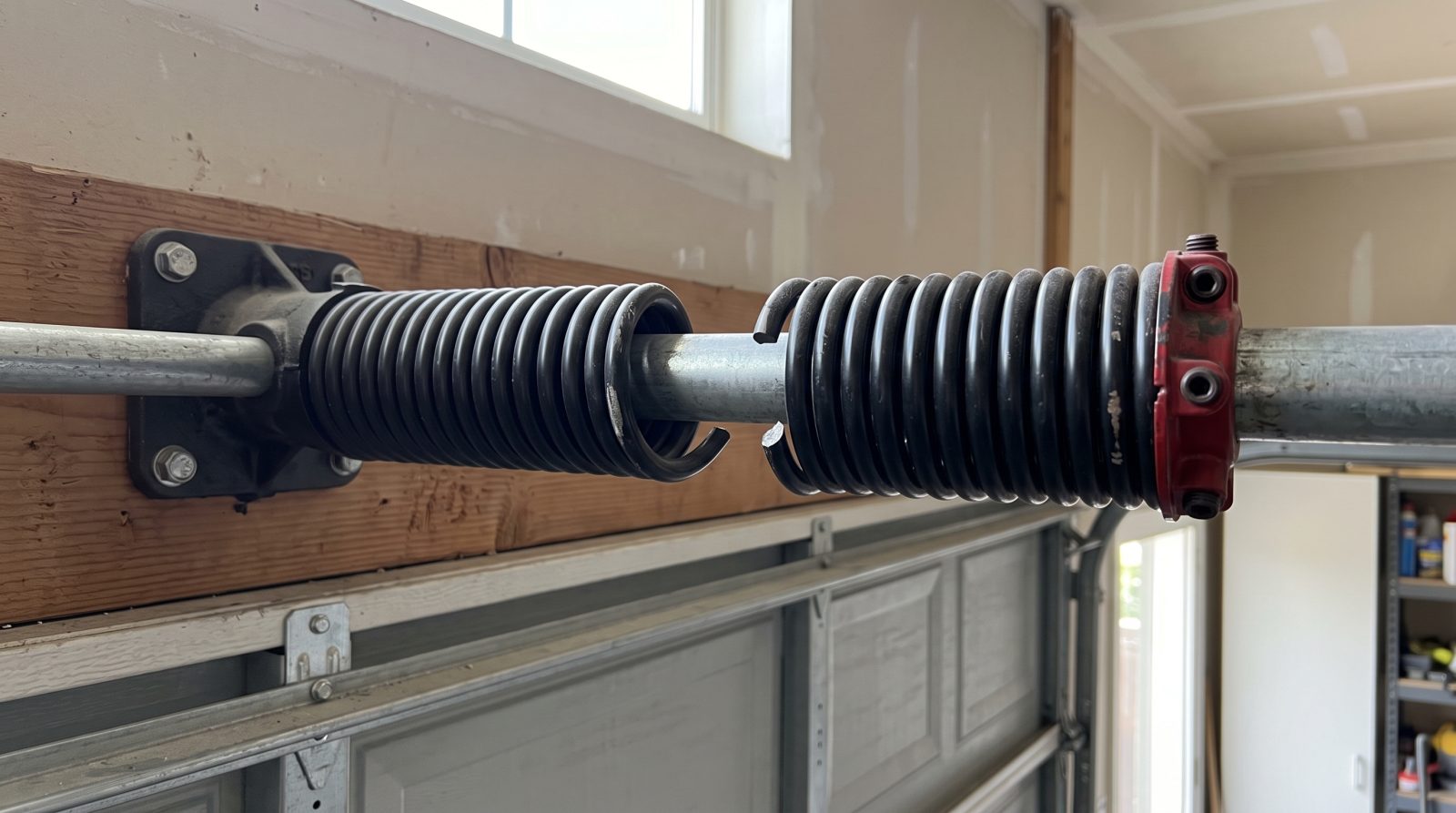
The Loud Bang: The Most Obvious Sign
If you heard a sharp, gunshot-like bang coming from your garage, there is a very good chance a torsion spring just snapped. The spring stores an enormous amount of energy while wound tight, and when the metal fails, all of that energy releases in a fraction of a second. Many Sacramento homeowners describe hearing it from inside the house and assuming something fell off a shelf or a car backfired in the street. The sound is the failure itself, not a warning before it.
After the bang, the door itself often looks fine and may even stay closed, which is why the noise gets dismissed. The real evidence is up on the spring. If you have a torsion spring mounted on the bar above the door, look for a visible gap of an inch or two in what should be a continuous tight coil. A broken spring separates cleanly, leaving two coiled ends with daylight between them.
Do not test the door after hearing this sound. With a broken spring, the counterbalance is gone and the full weight of the door is now unsupported. Leave it where it is and call for service.
- A single loud bang or pop from the garage, often mistaken for something falling
- A visible 1-2 inch gap in a coil that should be tightly wound end to end
- The door may still appear closed and intact despite the spring being broken
Visual Signs You Can Check Safely From the Ground
You can learn a lot about your springs just by looking, and none of it requires touching the hardware. Stand inside the garage with the door closed and the opener unplugged for peace of mind, then look at the spring system. Most homes have one of two setups: a torsion spring (or two) on a metal shaft above the door, or a pair of extension springs running along the horizontal tracks on each side near the ceiling.
For torsion springs, the telltale sign is that gap we mentioned, plus the spring ends sitting at slightly different angles. For extension springs, a break usually shows as one spring noticeably stretched out, sagging, or hanging loose while the other still has tension. You may also see the safety cable that runs through an extension spring exposed or dangling.
Look for secondary clues too. Loose, frayed, or dangling lift cables on either side of the door often appear right after a spring failure because the system is no longer balanced. Rust along the coils is a quieter sign that a Sacramento garage's seasonal humidity swings and Delta breeze moisture have been eating at the metal, which shortens spring life and can be the root cause of an early break.
- Torsion spring: a clear gap in the coil above the door
- Extension spring: one side stretched, sagging, or hanging loose
- Lift cables that have gone slack, frayed, or fallen off their drums
- Rust or flaking along the spring coils from seasonal moisture
Behavior Changes: How a Failing Spring Acts
Not every spring goes out with a bang. Springs weaken gradually as they lose tension, and the door's behavior is often the first thing to change. The most common complaint we hear is that the door suddenly feels heavy or refuses to open all the way. If your opener strains, hums, runs, and then stops or reverses without lifting the door, the motor is doing its job but has lost the spring's help, and it simply cannot move the full dead weight on its own.
Another classic symptom is a door that opens a few inches and stops, or one that drops fast and slams shut instead of lowering smoothly. With a healthy spring, a door should hold its position roughly halfway up when you lift it manually (after releasing the opener). If you try this and the door crashes down or shoots up, the counterbalance is off and a spring is likely the culprit. Be ready to step clear if you test this; never put fingers between the door sections or in the track.
You may also notice the door opening crooked, with one side lifting faster than the other. On a two-spring system, that usually means one spring has failed and the remaining spring is fighting the imbalance. Jerky, uneven movement and new grinding or scraping in the tracks frequently trace back to spring trouble rather than the rollers.
- Opener runs or hums but the door barely moves or won't lift fully
- Door opens a few inches then stops, or slams down hard
- Door rises or lowers crooked, with one side lagging
- Manual lift feels far heavier than it used to
Why Garage Door Springs Break (Especially in Sacramento)
Springs are wear parts with a finite lifespan, usually measured in cycles. One cycle is one full open and one full close. A standard spring is built for a set number of cycles, and a busy family that runs the door up and down many times a day will simply reach that number sooner than a household that uses it twice a day. This is why a spring can break on an ordinary morning with no obvious trigger: it simply ran out of cycles.
Sacramento's climate plays a real role too. Our hot, dry summers and cool, damp winters create a constant expansion and contraction cycle in the steel, and the moisture that rolls in off the Delta can leave a thin film on bare metal that promotes rust. Cold mornings are especially hard on springs because metal becomes more brittle when temperatures drop, which is why a lot of breaks happen on the first chilly day after a warm stretch. Garages in older Sacramento neighborhoods, where the original builder-grade springs may still be in place, are particularly prone to age-related failure.
Maintenance, or the lack of it, is the other big factor. Springs that are never lubricated run with more friction, wear faster, and rust more readily. The good news is that most of these causes are predictable, which is why a quick inspection can often catch a tired spring before it strands you with the door shut and your car inside.
- Normal cycle fatigue: springs simply wear out with use over time
- Temperature swings between hot Sacramento summers and cold mornings stress the steel
- Delta and seasonal moisture cause rust on unprotected coils
- Lack of lubrication accelerates friction, wear, and corrosion
Why Spring Replacement Is Not a DIY Job
It is tempting to treat a broken spring like any other home repair, but this is genuinely one of the most dangerous parts of a garage door. A torsion spring under load holds tremendous stored energy. Winding or unwinding one without the correct winding bars and technique can cause the bars to fly out or the spring to release violently, and serious hand, face, and head injuries happen to homeowners every year attempting exactly this. The risk is not theoretical.
There is also a precision side that gets overlooked. Springs are sized to the specific weight and height of your door, and installing the wrong wire gauge, length, or wind direction will leave the door unbalanced, burn out your opener prematurely, or send the door crashing. On two-spring systems, the standard practice is to replace both springs at once even if only one broke, because the second is the same age and almost always next in line. That balance work, plus re-tensioning the cables correctly, is what makes the door safe and quiet again.
This is exactly the kind of repair our mobile service is built for. We come to your home or business anywhere in the Sacramento area, bring the right springs and tools to your driveway, and handle the wind-up safely so you are not gambling with a part that can hurt you. If you have spotted any of the signs above, the safest move is to leave the door alone and request a free quote rather than risk a manual fix.
- Torsion springs store enough energy to cause severe injury when mishandled
- Wrong spring size or wind direction leaves the door unbalanced and unsafe
- Both springs are typically replaced together so they wear evenly
- Mobile service means we bring the parts and tools to your Sacramento driveway