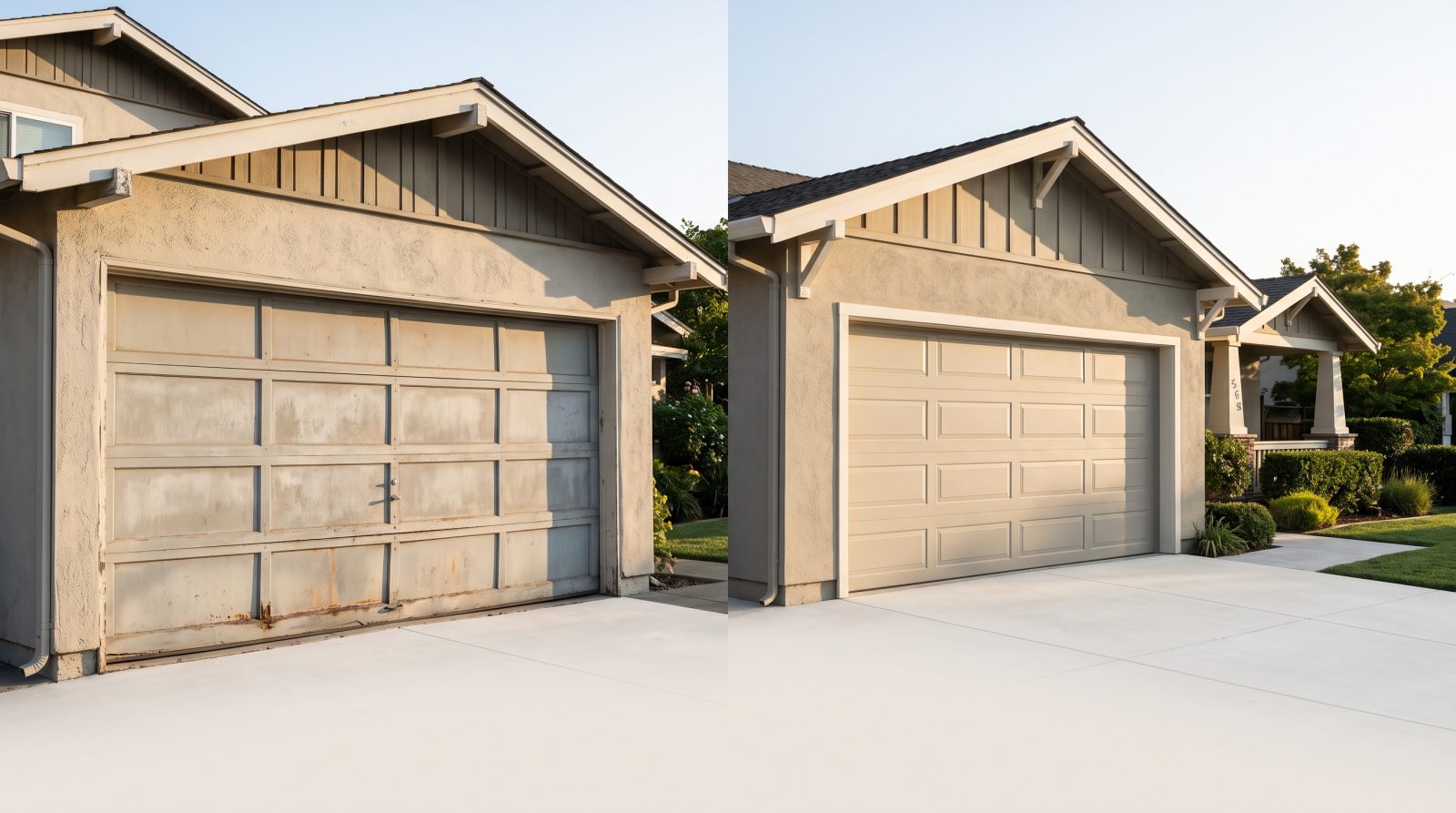
The Short Answer: Typical Garage Door Lifespans
When people ask how long a garage door lasts, they're usually asking about three separate systems that wear out at very different rates. The door panels themselves are the long-haul part of the equation. The opener is the electronics-and-motor middleman. The springs are the hardest-working component of all, and they're almost always the first thing to fail. Treating them as one unit is the mistake that leaves homeowners surprised when a five-year-old door suddenly won't budge because a single spring snapped.
Here in Sacramento, the climate is the variable that bends every one of these numbers. A door in a shaded, well-built garage in Land Park can comfortably reach the top of its expected range. The same door on a south- or west-facing garage in Natomas or Elk Grove, baking in afternoon sun and cycling through dry summers and damp winters, often lands at the lower end. Use the ranges below as a planning baseline, not a guarantee.
The other major factor is how often you open and close the door. Springs and openers are rated in cycles, not years. A two-car household that uses the garage as its main entrance can run two to four times the cycles of a home that only uses the door on weekends, which can cut a decade of calendar life down to five or six years of real use.
- Garage door (panels and frame): roughly 15 to 30 years, depending on material and exposure
- Garage door opener (the motor unit): roughly 10 to 15 years
- Torsion or extension springs: roughly 7 to 12 years, often measured as 10,000 cycles
- Rollers, hinges, and cables: roughly 7 to 15 years, longer with regular lubrication
- Weather seals and bottom astragal: roughly 3 to 7 years in the Valley sun
How Long the Door Itself Lasts (and What Sacramento Does to It)
The door slab is the part most homeowners think of as the garage door, and it's the most durable component by far. A quality steel door can serve 20 to 30 years, while wood and composite doors vary more widely based on upkeep. The catch is that the door rarely dies all at once. It fades, dents, delaminates, or warps long before it stops functioning, and that slow decline is heavily shaped by where you live.
Sacramento's intense, direct summer heat is the biggest enemy of the door slab. Steel and aluminum doors expand in the heat and contract overnight, and that daily flexing slowly stresses panel seams and paint. Dark-colored doors on west-facing garages soak up the most heat and tend to fade and chalk faster. Wood doors face the opposite seasonal threat: our long dry summers pull moisture out of the wood, then winter rain swells it back, and that repeated cycle is what cracks finishes and loosens joints.
Older neighborhoods like East Sacramento, Curtis Park, and Oak Park often have doors well past the 20-year mark, sometimes original single-layer steel or vintage wood that's simply at the end of its service life. Newer developments in Folsom, Roseville-adjacent corridors, and South Sacramento tend to have insulated steel doors that hold up better but still need their hardware serviced to reach full lifespan. No matter the age, a door that still looks fine can hide failing balance and worn hardware underneath, which is why a hands-on inspection beats guessing from the curb.
- Insulated steel and aluminum: longest, most heat-stable choice for Valley garages
- Single-layer (non-insulated) steel: more prone to denting and heat-driven fade
- Wood and wood-composite: beautiful but needs refinishing every few years to survive dry summers
- Watch for: rust at the bottom panel, separating laminate, panels that flex or rattle, and chalky faded paint
How Long Garage Door Openers Last
The opener is the powered unit mounted to your garage ceiling, and it typically runs 10 to 15 years. Unlike the door, the opener is a true wear item with a motor, a drive system, a logic board, and sensors, all of which can fail independently. The motor itself often outlives the electronics, so it's common for an otherwise-healthy opener to be sidelined by a fried circuit board or a worn drive gear.
Sacramento garages add two specific stresses. First, attached garages here can hit punishing interior temperatures in summer, and sustained heat is hard on circuit boards and lubricants. Second, our fine Valley and foothill dust drifts into the unit and the photo-eye sensors, which is a leading cause of openers that reverse for no reason or refuse to close. A quick sensor cleaning and re-alignment resolves a surprising share of service calls that homeowners assume mean a dead opener.
Drive type also matters for how an opener ages. Chain drives are durable but get louder and looser as they wear. Belt drives run quieter and tend to age gracefully. Older units with worn gears, failing capacitors, or no modern safety reversal features are often worth replacing rather than repeating repairs on, especially once a unit passes the 12-year mark and parts get harder to source. We can test the motor, sensors, and safety reversal on-site and tell you honestly whether a repair or a replacement is the smarter spend.
- Most openers last 10 to 15 years; the logic board often fails before the motor
- Heat-soaked attached garages and dust intrusion shorten opener life in the Valley
- Random reversing or refusal to close is often dirty or misaligned safety sensors, not a dead unit
- Replacement makes sense when parts are obsolete, the unit lacks auto-reverse, or repairs stack up
How Long Springs Last (the Part That Fails First)
Springs do the real heavy lifting. They counterbalance the full weight of the door so the opener, and you, only have to nudge it. Because they store and release enormous tension on every single use, they wear out faster than anything else on the system. The standard rating is around 10,000 cycles, which is why most springs last 7 to 12 years in a typical home and far less in a high-use household where one open-and-close counts as a full cycle.
If your garage is your family's primary entrance, you might cycle the door six, eight, or more times a day. At that pace, a 10,000-cycle spring can reach the end of its life in just a few years. Temperature swings matter too: steel springs are slightly more brittle in cold morning air, which is why broken springs so often announce themselves with a loud bang on a chilly Sacramento winter morning when the door is first opened.
A broken spring is one of the most common emergencies we're called for, and it's also one of the most dangerous parts to handle. Springs are under extreme tension, and a slip during a DIY attempt can cause serious injury. The warning signs usually show up before a full break, so it's worth knowing them. If you see any of these, stop using the door and have it looked at, because running an opener against a failing spring can damage the motor and bend the door.
- Typical spring life is 7 to 12 years, or about 10,000 cycles of use
- High-use garages can burn through that lifespan in just a few years
- Warning signs: the door feels heavy by hand, opens crooked, or slams down fast
- A visible gap or separation in the coil means the spring has already snapped
- Never adjust or replace springs yourself; the stored tension makes it a job for a technician
How to Stretch Every Year Out of Your System
The single biggest lever on garage door lifespan is maintenance, and it costs far less than premature replacement. Most of the failures we see in the Sacramento area aren't from age alone; they're from dry rollers, dusty sensors, loose hardware, and unbalanced springs that quietly overwork the opener for months before something breaks. A door that's kept balanced and lubricated reaches the top of its range instead of the bottom.
Local conditions make a simple maintenance routine especially worthwhile here. Our dust means sensors and tracks need wiping more often than in milder climates. Our heat means lubricants break down faster, so the door benefits from re-lubrication at least a couple of times a year rather than once. And our dry-wet seasonal swing means it's smart to check seals and hardware ahead of both the summer heat and the winter rains. A few minutes of attention, plus an annual professional tune-up, is what separates a door that lasts 25 years from one that needs major work at 12.
Because we're a fully mobile garage door company, all of this happens at your home, on your schedule, with no trip to a shop. We can inspect the full system, test the balance and safety reversal, swap worn rollers and seals, and replace springs or service the opener right in your driveway, anywhere across the Sacramento area. If you're not sure where your door stands, the safest move is a same-day on-site inspection rather than waiting for the morning it won't open.
- Lubricate rollers, hinges, and springs a few times a year to fight heat and dust
- Wipe down photo-eye sensors and clear the tracks to prevent false reversals
- Test the door's balance: a healthy door stays put when lifted halfway by hand
- Replace worn weather seals before summer heat and winter rain push through
- Book an annual professional tune-up to catch worn parts before they fail