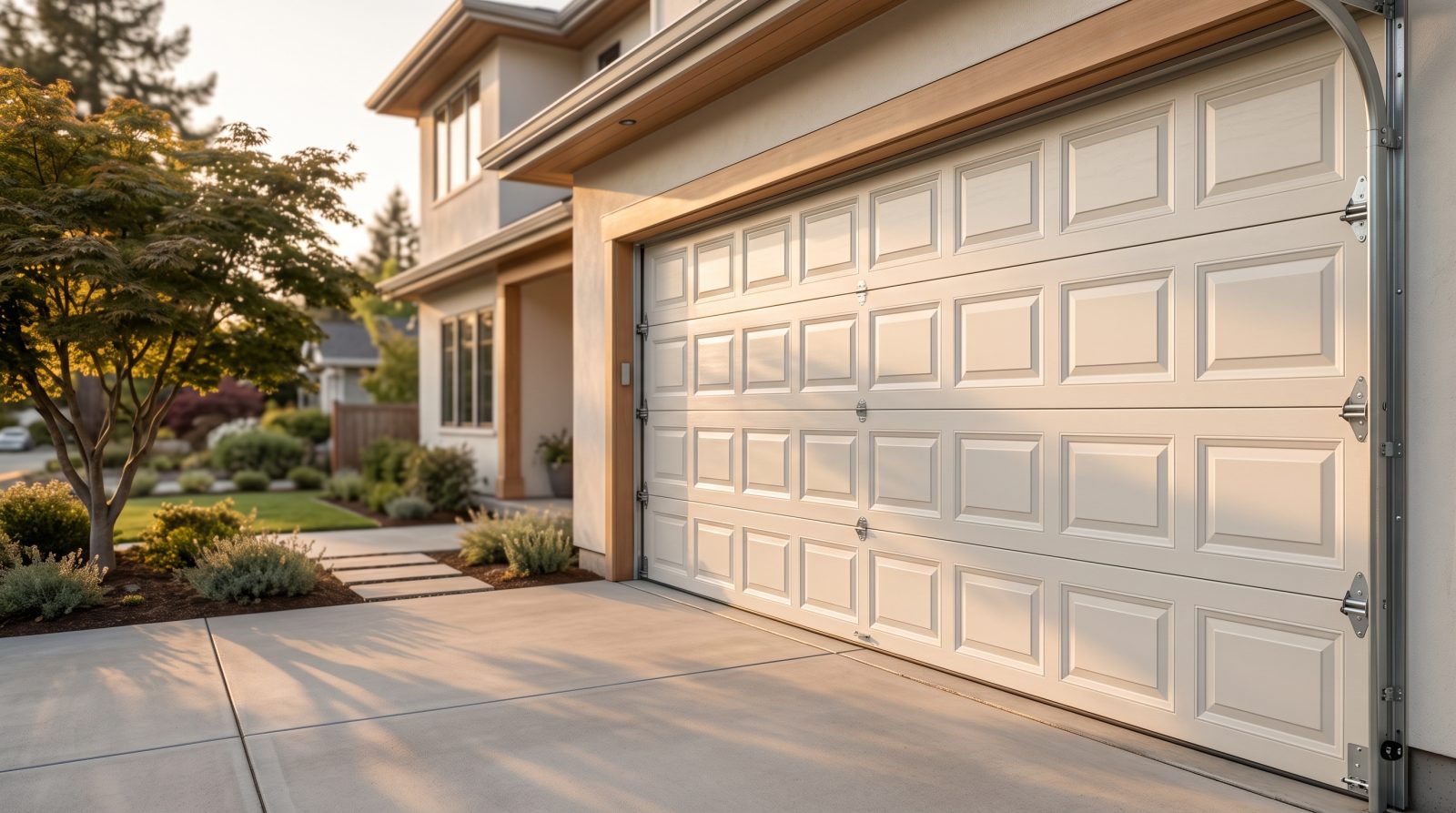
What a sectional garage door actually is
A sectional garage door is built from several horizontal panels (most residential doors use four or five) hinged together so the door can bend. Each panel spans the full width of the opening, and the hinges between them let the door flex from vertical to horizontal as it travels. When the door is closed, the panels stack into a flat, sealed wall. When it opens, the panels articulate around a curved section of track and glide back along horizontal rails near the ceiling, parking the whole door flat overhead and out of the way.
This design is why sectional doors are the default choice across Sacramento neighborhoods. Because the door lifts straight up before sliding back, it does not swing outward into the driveway, which matters on the tighter lots common in older areas like Curtis Park, East Sacramento and Tahoe Park. The sealed panel face also does a real job blocking the radiant heat of a Central Valley summer afternoon and the morning chill in winter, helping keep an attached garage and the rooms above it more comfortable.
The panels themselves come in steel, aluminum, composite and wood. Steel is by far the most common locally because it resists warping in our dry heat and shrugs off the dust and pollen that ride in on the Delta breeze. Whatever the material, every sectional door relies on the same core mechanical system to move that weight safely and quietly.
How the panels, springs, rollers and tracks work together
The genius of a sectional door is that it makes a door weighing well over a hundred pounds feel almost weightless. That is the job of the spring system, not the opener. The opener only guides the door and holds it in position; the springs do the heavy lifting.
Most Sacramento sectional doors use a torsion spring system: one or two tightly wound springs mounted on a steel shaft above the door opening. As the door closes, cables wind the springs tighter, storing energy. As the door opens, that stored energy releases and counterbalances the weight of the panels so the door rises smoothly. Some older or lighter doors instead use extension springs that run along the horizontal tracks and stretch as the door closes. Both types are under serious tension and are the single most safety-critical part of the door.
Guiding all of this are the rollers and tracks. Rollers, usually with a stem and a wheel, sit in the vertical and horizontal tracks and let the panels travel with minimal friction. The tracks form that signature curve that turns vertical motion into horizontal. Hinges connect the panels and also carry roller brackets. When every part is aligned and lubricated, a sectional door should open and close in a few seconds with little more than a soft hum.
- Panels: hinged horizontal sections that flex as the door travels and stack flat when closed
- Torsion or extension springs: store and release energy to counterbalance the door's weight (the real workhorse)
- Cables: connect the bottom of the door to the spring system and must stay seated on the drums
- Rollers: ride inside the tracks so panels move with low friction
- Tracks: the steel rails (vertical, curved, and horizontal) that route the door overhead
- Hinges and brackets: tie the panels together and anchor rollers and the bottom cable
- Opener: guides and holds the door but is NOT what carries the weight
Common sectional door problems we see in Sacramento
Because a sectional door is a balanced mechanical system, a failure in one small part throws off the whole door. The most common call we get is a broken torsion spring. Springs are rated for a finite number of cycles (each open-and-close is one cycle), and after years of daily use they fatigue and snap, often with a loud bang. Once a spring breaks, the door becomes its full dead weight: it may refuse to open, slam down, or feel impossibly heavy by hand. This is not a DIY fix because the remaining tension is dangerous.
Sacramento's climate adds its own wear. The fine dust and pollen that settle through spring and summer work into rollers and hinges, and combined with dry heat they dry out factory lubrication, leaving doors that grind, squeak or stick. We also see rollers that wear flat or pop out of alignment, and panels that have been dented or bowed by a backed-into bumper, a basketball, or simply age. A bent track or a roller off its rail will make a door bind, jerk, or stop partway.
Cables are another frequent culprit. A frayed or snapped cable lets one side of the door drop, leaving the panels crooked in the opening and the whole door unsafe to operate. And misaligned safety sensors near the floor, or a door that has drifted out of balance, will make even a healthy opener reverse, hesitate, or struggle. Many of these issues start small and get worse fast, so an early diagnosis usually means a smaller repair.
- Broken torsion or extension spring (door won't open or feels extremely heavy)
- Snapped or frayed lift cables leaving the door crooked or stuck
- Worn, flat-spotted, or jumped rollers that bind in the track
- Dented, bowed, or cracked panels from impact or age
- Dry, dusty rollers and hinges that grind and squeak in our climate
- Bent or misaligned tracks causing the door to jerk or stop partway
- An out-of-balance door that overworks and shortens the life of the opener
How our mobile repair works across the Sacramento area
We are a mobile garage door service, which means we bring the shop to your driveway. There is no storefront to visit and no need to move a heavy, broken door. Our technician arrives with the springs, rollers, cables, hinges, and hardware to handle the large majority of sectional door repairs on the spot, so most jobs are diagnosed and finished in a single same-day visit.
Every visit starts with a full safety check, not just a look at the part you called about. We test the door's balance, inspect both springs and cables, check the rollers and track alignment, and confirm the opener's safety reverse is working. That matters because a single worn part often signals that the whole system is due for attention, and catching it early on the rest of the door saves you a second breakdown. When we recommend a repair, we explain what failed and why in plain language before any work begins.
We serve homeowners throughout the greater Sacramento region, including Midtown, East Sacramento, Land Park, Natomas, North and South Sacramento, plus surrounding communities like Elk Grove, Roseville, Folsom, Citrus Heights, Rancho Cordova and Carmichael. Whether you are in a 1950s ranch with an original single-panel-style setup that has been converted to sectional, or a newer two-car build with a heavy insulated steel door, the mechanical principles are the same and so is our approach.
Repairing versus replacing a sectional door, and what it can cost
The good news with sectional doors is that they are highly repairable. Because the door is made of independent components, a single broken part is usually replaced without touching the rest of the door. A snapped spring, a worn set of rollers, a frayed cable, or even one damaged panel can frequently be swapped out, restoring the whole door for a fraction of the cost of replacement. We always look at whether a targeted repair will give you a safe, reliable door before suggesting anything bigger.
Full replacement makes more sense in specific situations: multiple panels are cracked or rusted through, the door has been hit hard enough to twist the structure, several systems are failing at once, or you simply want to upgrade to a better-insulated, quieter model. We will give you an honest read on which path is the better value for your particular door rather than defaulting to the most expensive option.
On cost, it helps to know the general landscape, though every door is different and the only accurate number comes from seeing yours. As broad industry ranges for residential sectional doors, a spring replacement commonly runs in the low-to-mid hundreds of dollars depending on spring size and whether one or two are replaced; roller or cable replacement often falls in a similar lower range; a single replacement panel varies widely with the door's brand, color, and design; and a complete new sectional door, installed, typically spans from several hundred to a few thousand dollars depending on size, material, and insulation. These are industry ranges to set expectations, not a quote. Request a free quote and we will assess your door and give you a clear price before any work starts.
- Repair usually wins: most failures are a single part, swapped without replacing the whole door
- Replace when: multiple panels are damaged, the structure is twisted, or several systems fail at once
- Spring, roller, and cable repairs generally fall in the lower hundreds (industry range)
- A full installed sectional door spans several hundred to a few thousand dollars (industry range)
- Every door is different, so these are ranges, not quotes; we price your specific door on site