Why Your Garage Door Opener Stops Working
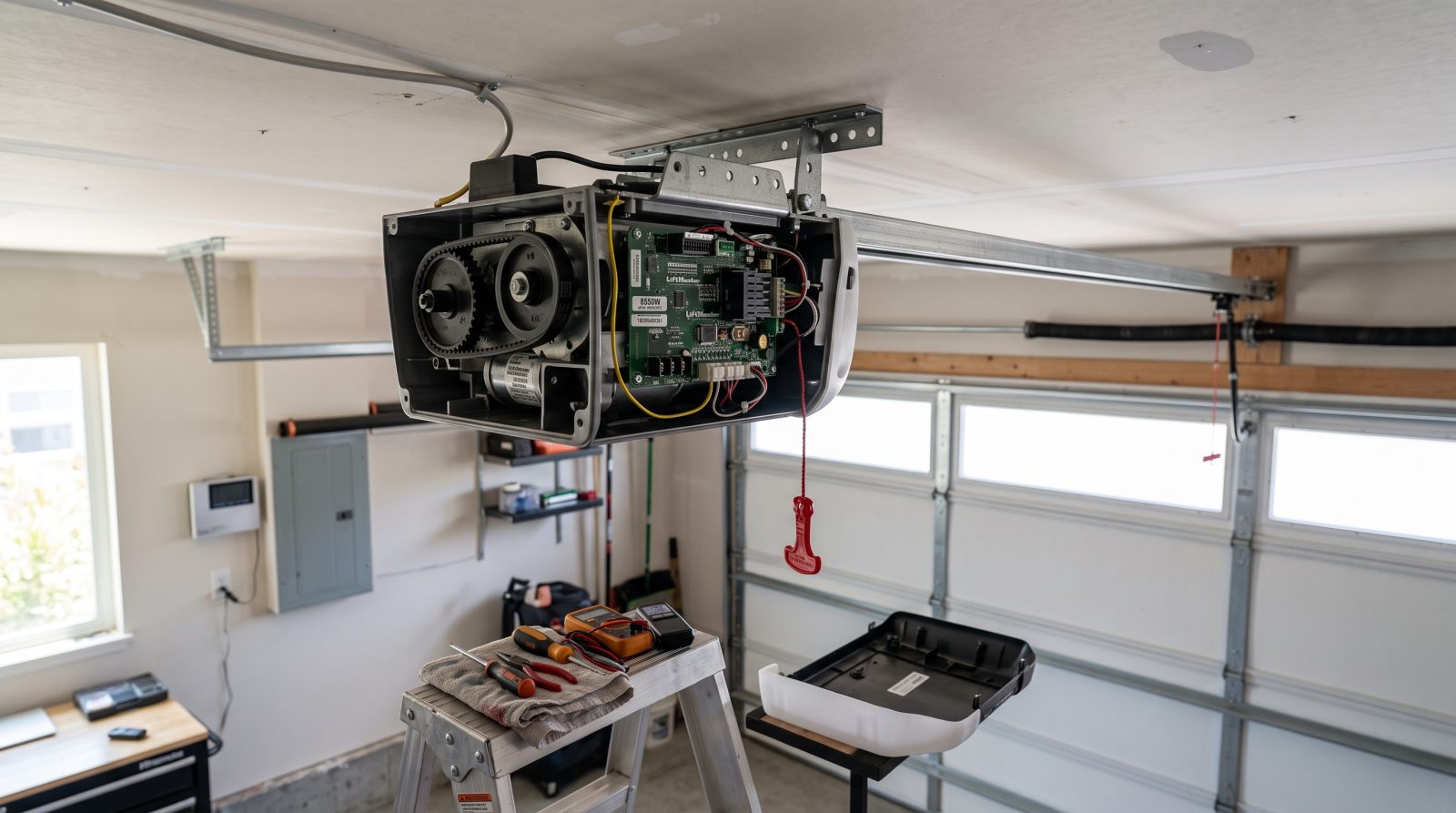
A garage door opener is a small system of parts that all have to cooperate: an electric motor, a gear-and-sprocket drive, a logic (circuit) board, a pair of photo-eye safety sensors near the floor, a wall button, and your handheld remotes or keypad. When the door won't move, the fault could sit in any one of them, which is why a careful diagnosis matters more than guessing. Replacing a whole opener when the real problem is an inexpensive gear is one of the most common ways homeowners overpay.
The single most frequent failure we see is the drive gear. Most chain- and belt-drive openers use a plastic nylon gear that meshes with a metal worm shaft on the motor. Over years of cycles, that nylon strips its teeth, and a telltale sign appears: the motor hums or runs for a few seconds but the door doesn't budge. The motor is fine; the gear connecting it to the door has simply worn out.
Logic boards are the next common culprit, and Sacramento's climate plays a role. Summer attic-and-garage heat well over 100 degrees, combined with the surge-prone grid that comes with heavy AC season load, is hard on circuit boards and capacitors. Boards also get hit during the rare but real lightning and storm surges that roll through the valley in winter. A failed board often shows up as an opener that's completely dead, behaves erratically, or flashes diagnostic LED codes.
The rest of the list rounds out quickly: misaligned or dirty photo-eye sensors (the door reverses or won't close and a light blinks), a motor capacitor that's lost its charge (the classic hum with no movement), worn remotes or a dead keypad battery, stripped trolley carriages, and broken travel limit settings that make the door stop short or slam down. Knowing which of these it is, is the whole job.
Troubleshooting Before You Call: Safe Checks You Can Do
A few quick checks separate a real opener failure from something you can clear in two minutes. Do these first, and stop the moment anything involves the springs or the door's heavy hardware.
If none of these resolve it, that's useful information, not a wasted effort. Tell us what you tried and what the opener did, and we'll arrive with the right parts the first time.
- Check power first: confirm the opener is plugged in and the outlet has power (test it with a phone charger). A tripped GFCI or breaker in the garage is a surprisingly common 'dead opener.'
- Try the wall button, not just the remote. If the wall button works but the remote doesn't, you likely have a remote, keypad, or battery problem, not an opener failure.
- Replace the remote battery and re-test. Most remotes use a CR2032 or similar coin cell, and a weak battery causes short or inconsistent range.
- Look at the safety sensors near the floor on each side of the door. If the door won't close and the opener light blinks, gently clear cobwebs or dust and make sure both sensors point at each other (one steady light on each is the goal).
- Listen to the motor. A hum or brief run with no door movement points to a stripped gear or failed capacitor, not a dead motor. A completely silent opener points to power or the logic board.
- Pull the emergency release cord (the red handle) and lift the door by hand. If it's extremely heavy or won't stay up halfway, the problem may be a spring, not the opener, and you should stop and let us inspect it.
What a Sacramento Garage Door Opener Repair Visit Looks Like
Because we're mobile, the entire repair happens at your home. We bring the tools, the common replacement parts, and the testing gear to your driveway, whether you're in Land Park, Natomas, Elk Grove, Roseville, Folsom, Citrus Heights, or Carmichael. There's nothing to disconnect, box up, or transport.
A visit starts with a real diagnosis. We test power at the outlet, run the opener through a cycle, check the logic board for diagnostic codes, inspect the drive gear and trolley, verify sensor alignment, and confirm the travel limits and force settings. Only after we know the actual cause do we talk repair-versus-replace, so the recommendation matches the part that failed rather than a default upsell.
Many common fixes are completed in the same visit. We carry the parts that fail most: nylon drive gears and gear kits, capacitors, sensors, remotes, keypads, and trolley carriages. For a full logic board or a complete opener replacement, we'll confirm the model and the right unit before fitting it. Where it makes sense, we'll also explain the trade-off between repairing an older opener and replacing it with a modern unit that adds quieter belt drive, battery backup (useful during summer outages), and rolling-code or smartphone control.
We also handle the safety side of the job. After any opener repair we re-test the auto-reverse and photo-eye safety features, because a door that doesn't reverse on contact is a genuine hazard, especially in homes with kids or pets. A working opener that fails its safety reversal isn't a finished job in our book.
Motor, Gear, or Logic Board: How We Tell Them Apart
The three big-ticket internal failures, the motor, the drive gear, and the logic board, all feel like 'the opener died,' but they sound and behave differently, and the cost gap between them is large. Pinpointing the correct one is where a careful technician earns their keep.
A stripped drive gear is usually the cheapest of the three to fix and the most commonly misdiagnosed. The motor still spins, so it tricks people into thinking the unit is fine, while the door just sits there. A gear or gear-and-sprocket kit replacement is a straightforward repair on most chain and screw-drive openers.
A failed logic board is an electronics replacement. Symptoms include a completely unresponsive opener despite confirmed power, erratic behavior, no response to any remote or wall button after reprogramming, or diagnostic LED codes that point to the board. Sacramento's heat and grid surges make this a real-world failure here, not a rare one.
A genuinely dead motor or one with a failed capacitor is less common than people assume. A bad capacitor often presents as a hum with no movement and is a relatively inexpensive part; a truly burned-out motor usually means the opener is near the end of its life, and replacement is often the smarter spend. We'll lay out the options honestly so you can decide based on the actual part, the age of the unit, and what it would cost to keep an aging opener limping along.
What Opener Repairs Cost in the Sacramento Area
Pricing depends on the part that failed and the brand of opener, so the honest answer is a range rather than a flat number until we've seen it. The figures below are general industry ranges to set expectations, not a quote; your actual price is confirmed on-site after diagnosis, with no surprise add-ons.
Small fixes sit at the low end: reprogramming or replacing a remote or keypad, realigning or replacing safety sensors, and adjusting travel and force limits are typically the most affordable repairs. Mid-range jobs include drive-gear kits and capacitors, which restore a humming or stalled opener without replacing the whole unit. The higher end covers full logic-board replacement and complete opener replacement, where you're paying for a new motor unit, the rail, and installation.
A few local realities affect the math. Many Sacramento-area homes, especially newer Elk Grove, Natomas, and Roseville builds, have two- and three-car garages with multiple openers, so a 'whole house' job can mean more than one unit. Older Midtown, East Sacramento, and Land Park homes sometimes pair a dated opener with original hardware, where it's worth checking the springs and rollers at the same time so you're not paying for two separate visits.
The most cost-effective path is almost always an accurate diagnosis up front. Replacing the specific failed component, rather than defaulting to a new opener, is usually the cheaper and faster route, and it's the one we recommend whenever the unit has good life left in it.