What a Smart Garage Door Opener Actually Does
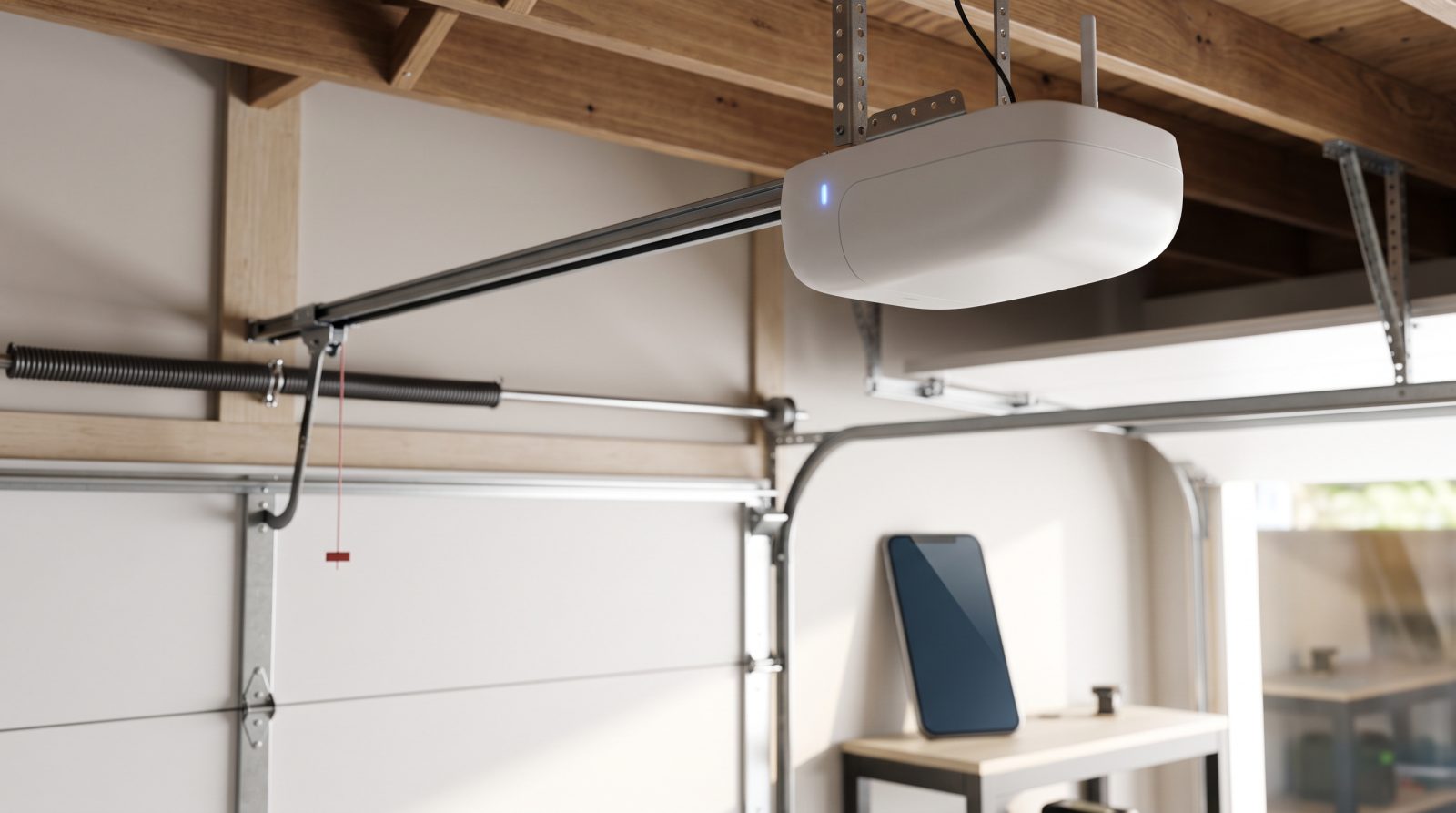
A "smart" garage door opener is simply an opener that can connect to your home WiFi and talk to an app on your phone. Once it is online, the door becomes another connected device in your home: you can see whether it is open or closed from anywhere, operate it remotely, and set rules so it tells you when something happens. The mechanical job of lifting the door is identical to a standard opener; the intelligence lives in the WiFi radio and the cloud service behind the app.
There are two ways to get there. Some newer openers have WiFi and the smart controller built into the motor head from the factory, so the unit pairs with an app out of the box. Others are made smart by adding a small retrofit hub, a separate device that mounts near the opener, plugs into power, and uses a door-position sensor to read whether your existing door is up or down. Both approaches end at the same place: real-time status and control from your phone.
The features most Sacramento homeowners actually use day to day are status-at-a-glance (did I leave it open before driving to work downtown?), remote close, and an alert if the door has been open for a set number of minutes. More advanced setups add scheduled auto-close, geofencing that nudges you when you leave home with the door up, shared access for family members or a house cleaner, and in-app event history showing every open and close.
- Remote open/close and live open-or-closed status from anywhere with signal
- Alerts when the door is left open, or opened at an unexpected time
- Auto-close on a schedule or after a set number of minutes open
- Shared, revocable access for family, guests, and service providers
- Activity history so you can see exactly when the door moved and who triggered it
WiFi, App, and Voice Control: The Main Systems Explained
Most smart openers run on one of a few ecosystems, and knowing which one you have (or are buying into) matters because it decides which apps and voice assistants will work. The two you will encounter most often in Sacramento garages are Chamberlain/LiftMaster's MyQ platform and the Aladdin Connect system used on Genie and some other brands. Both give you a phone app and door alerts; they differ in which third-party services and smart-home hubs they integrate with, and those integrations change over time.
Voice control is where expectations and reality often diverge. For safety reasons, voice assistants are typically allowed to close a garage door by voice but require a PIN, a confirmation step, or the app to open it, because an opener that opens on a casual spoken command is a security and safety hazard. So "is the garage closed?" and "close the garage" usually work smoothly, while opening by voice alone is intentionally locked down. That is a feature, not a flaw.
App control depends entirely on your garage having a usable internet connection. This is the single most common thing we run into on smart-opener calls in the Sacramento area: the home router sits in a front office or living room, the garage is at the far end of the house or a detached structure, and the WiFi signal that reaches the opener is too weak to stay connected. The opener works fine on the wall button and remote, but the app keeps showing "offline." The fix is almost always about WiFi coverage to the garage, not the opener itself.
Delivery integrations are a newer category worth understanding. Some platforms can grant a one-time, monitored opening for in-garage package delivery from major carriers. It is genuinely useful for porch-pirate-prone neighborhoods, but it ties your door to a third-party service and a camera, so weigh the convenience against having an outside company momentarily control your garage.
- MyQ (Chamberlain/LiftMaster) and Aladdin Connect (Genie and others) are the systems you will see most
- Voice assistants generally close by voice but require a PIN/confirmation to open, by design
- Every app feature relies on a stable WiFi signal reaching the opener in the garage
- Check current integrations before buying; supported apps and services shift year to year
- In-garage delivery is convenient but hands temporary door access to an outside service
Retrofit Hub vs. New Smart Opener: Which Makes Sense
If your current opener works well and is reasonably modern, you usually do not need to replace it to get smart features. A retrofit hub can add app control to a wide range of existing openers, especially those with the safety photo-eye sensors that have been federally required on residential openers since 1993. This is often the most cost-effective path: you keep the motor you have and bolt on the brains. The catch is compatibility; some very old openers, certain security protocols, and some screw-drive or oddball units do not play nicely with every hub, so it pays to confirm your exact model before buying.
Replacing the whole opener makes more sense when the existing unit is near the end of its life, is noisy, lacks modern safety features, or uses outdated rolling-code security. A new opener with WiFi built in gives you the cleanest setup: a single app, quieter belt-drive operation, battery backup so the door still works during a power outage, and current security. If you are already facing a repair on an aging opener, putting that money toward a modern smart unit is often the better long-term value.
There is also a middle question many homeowners miss: the springs and the door itself. A smart opener controls a system; it does not fix a system. If your torsion or extension springs are worn, your rollers are dragging, or the door is out of balance, adding WiFi just gives you a connected, struggling door, and a strained motor will fail sooner. We assess the whole assembly on site so the smart features ride on top of a door that is actually healthy.
- Retrofit hub: often the cheapest route, keeps your working opener, but confirm model compatibility first
- New smart opener: best for old, loud, or outdated units; adds battery backup and modern security
- Battery backup matters here for power outages, and California requires it on newly installed residential openers
- Smart control does not fix mechanical problems; worn springs and rollers should be addressed first
- If a major repair is already due, a new smart opener is often the smarter spend than patching an old one
Security: Keeping a Connected Garage Safe
Putting your garage on the internet adds convenience and a new surface to protect. The garage is often the real front door to a home; it connects to the interior and stores cars, tools, and bikes, so the security basics here are not optional. The good news is that the meaningful protections are simple and do not require any technical expertise.
Start with the account, not the gadget. Use a strong, unique password on the opener's app account and turn on two-factor authentication if the platform offers it, so a leaked password alone cannot open your door. Keep the opener's firmware and the app updated, since manufacturers patch security issues over time. When you give access to a family member, house cleaner, or contractor, use the app's shared-access feature with its own login rather than handing out your master password; that way you can revoke one person without resetting everyone.
Do not neglect the old-school basics either. Modern openers use rolling-code remotes that change the code each press, which defeats simple code-grabbing, but very old remotes with fixed codes are genuinely insecure and worth retiring. If you have a wall-mounted keypad, change the PIN periodically. And keep the manual emergency release cord in good shape, but be aware it can be a break-in point on some doors; we can advise on shielding it during a visit. Finally, enable the left-open alert, the fastest way a connected garage pays you back is telling you the door has been sitting open while you are away.
- Use a unique password plus two-factor authentication on the opener app account
- Keep opener firmware and the app updated so security patches actually apply
- Grant family and service providers their own shared access, never your master login
- Retire very old fixed-code remotes; modern rolling-code remotes are far harder to spoof
- Turn on the left-open alert and review access history periodically for anything unexpected
Installation and Smart Setup for Sacramento Homes
Smart openers are sensitive to local conditions, and the Sacramento Valley has a few that matter. Summer heat is the big one: an unconditioned garage can climb well past 100 degrees on a July afternoon, and that heat is hard on the opener's electronics, its WiFi radio, and any battery backup. We account for that during install, including how and where a retrofit hub is mounted, so the smart components are not cooking next to the hottest part of the ceiling. Heat also accelerates wear on lubricant and rollers, which is one more reason to keep the mechanical side tuned.
Connectivity is the other recurring theme. Sacramento has a wide mix of housing, from older bungalows in Land Park and East Sacramento with detached garages, to sprawling single-story homes in Natomas, Elk Grove, Roseville, and Folsom where the garage sits far from the router. In all of these, a weak signal at the opener is the number-one reason a perfectly good smart setup shows as offline. As part of a smart-opener visit we check the actual signal strength at the door and flag when a mesh node, extender, or access point near the garage is what is really needed.
Because we are a fully mobile garage door company, we bring the assessment and the work to your driveway anywhere in the greater Sacramento area. A typical smart-opener visit covers confirming compatibility with your existing door and opener, installing the hub or new unit, setting up the app and alerts, testing remote operation and auto-close, walking you through sharing access safely, and balancing and tuning the door so the new smarts sit on a system that is actually in good shape. If you are weighing options, the easiest first step is to call or request a free quote and tell us your opener brand and where your garage sits relative to your router.
- Sacramento summer heat stresses opener electronics and backup batteries; mounting and placement matter
- Detached and far-end garages (Land Park, East Sac, Natomas, Elk Grove, Roseville, Folsom) often need better WiFi to the door
- We test real signal strength at the opener and flag when a mesh node or extender is the real fix
- Mobile, we-come-to-you service across the greater Sacramento area, no need to haul anything in
- A visit covers compatibility, install, app and alert setup, safe access sharing, and tuning the door itself