First, Figure Out What Kind of "Won't Open" You Have
Before you troubleshoot anything, narrow down the symptom, because "my garage door won't open" actually describes several very different failures. The fix for a dead opener is nothing like the fix for a snapped spring, and trying the wrong one can waste time or get you hurt. Pay attention to what the door does, or doesn't do, when you press the button or pull the manual release.
Run through this quick mental checklist the next time the door fails. The answers will point you toward the right section below and tell you whether this is a five-minute DIY fix or a job for a technician.
- The opener motor hums or runs but the door doesn't move: likely a disconnected trolley, broken drive belt/chain, or a spring problem.
- Nothing happens at all when you press the button: think power, dead remote battery, or a tripped GFCI outlet.
- The door starts up a few inches then stops and reverses: almost always the safety sensors or a force/limit setting.
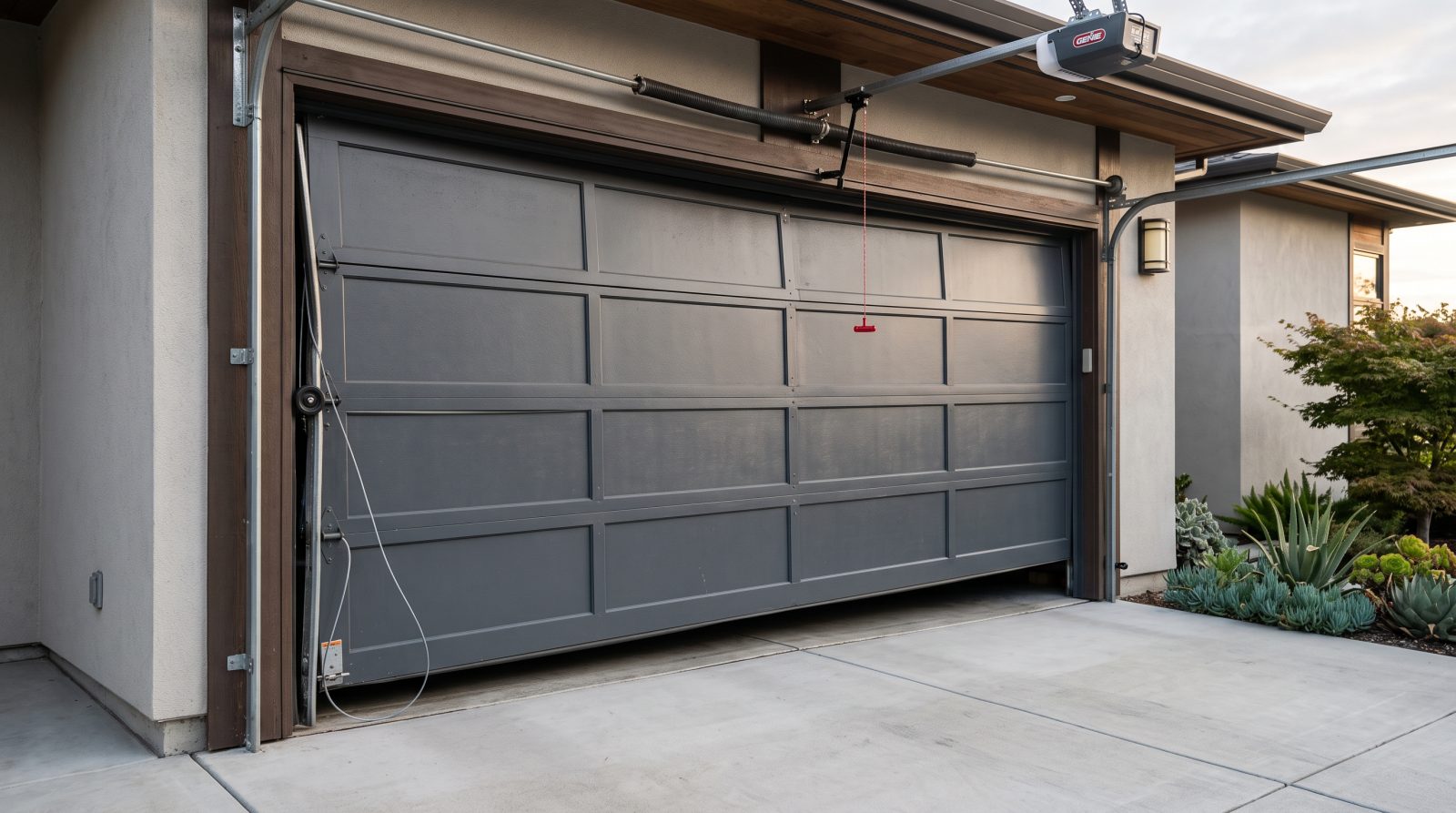
- The door is heavy, crooked, or you heard a loud bang recently: stop. This points to a broken spring or cable, which is not a DIY repair.
- The door is frozen or stuck after a cold Sacramento Delta morning: weather stripping may be iced to the slab, common on valley winter mornings.
The Safe DIY Checks (Do These First)
A surprising number of "broken" garage doors aren't broken at all. Before you assume the worst, work through these safe checks in order. None of them involve touching springs, cables, or the high-tension parts of the system, so they're appropriate for any homeowner.
Start with power. Garage door openers are usually plugged into a single ceiling outlet, and in many Sacramento-area homes that outlet shares a GFCI circuit. A tripped GFCI, a bumped plug, or a flipped breaker after a summer AC-load surge can cut power without any obvious sign. Confirm the outlet works, then reset the breaker if needed.
Next, check your remote and keypad. A weak remote battery is one of the most common false alarms. Try the hardwired wall button: if the wall button opens the door but the remote doesn't, you've found your culprit, replace the battery or re-pair the remote. If a wall keypad is acting up in the heat, note that direct afternoon sun on a west-facing garage can cook the electronics over time.
Finally, inspect the safety sensors, the two small units near the floor on each side of the door. Required by federal law on residential openers since the early 1990s, they stop the door from closing on a person or pet, but a misaligned or dirty sensor can also prevent normal operation and cause the door to reverse. Make sure both indicator lights are solid (not blinking), wipe the lenses, and check that nothing, a bike, a recycling bin, a stray cobweb, is breaking the beam.
- Confirm the opener is plugged in and the outlet has power; reset a tripped GFCI or breaker.
- Test the wall button vs. the remote to isolate a battery/remote issue.
- Realign and clean the two photo-eye safety sensors; look for steady, not blinking, lights.
- Clear anything blocking the door's path or the sensor beam.
- On cold mornings, check whether the bottom seal is frozen to the concrete before forcing the door.
When the Opener Runs but the Door Won't Move
If you hear the motor working but the door just sits there, the connection between the opener and the door has failed somewhere. The most innocent version of this is a disengaged trolley: the red emergency-release cord may have been pulled, leaving the opener running in "manual mode" while disconnected from the door. Re-engaging the trolley (usually by pulling the cord toward the motor or running the opener until it re-latches) often solves it instantly.
More serious versions involve the drive system itself. A worn belt, a stripped chain gear, or a broken plastic trolley gear inside the opener head will all let the motor spin freely while the door stays put. These are repairable, but they call for opener-specific parts and a bit of disassembly that's best left to a technician who can match components and reset the travel and force limits afterward.
There's one important test here. Carefully pull the manual release cord and try to lift the door by hand. A properly balanced door should rise smoothly and stay open about halfway on its own. If it slams down, won't budge, or feels brutally heavy, the issue is not the opener at all, it's the spring system. That's the next section, and it's the one where DIY ends.
- Check whether the emergency-release trolley was disconnected and re-engage it.
- Listen for grinding or free-spinning, which suggests a stripped gear, belt, or chain.
- Do the manual balance test: a healthy door lifts easily and holds halfway.
- If the door is very heavy by hand, suspect the springs, not the opener.
The Red Flags: Stop and Call a Pro
Some garage door failures are genuinely dangerous, and pushing through them is how people end up in the ER. Torsion and extension springs store an enormous amount of energy to counterbalance a door that can weigh well over 100 pounds. When a spring breaks, that force is released in an instant, and the cables, brackets, and bottom fixtures are all under similar loads. These are not parts to experiment with using household tools.
A broken spring is one of the most common reasons a door becomes too heavy to open. The telltale signs are a loud bang from the garage (often heard the night before), a visible gap in the tightly-wound spring above the door, a door that opens a few inches and stops, or one that feels like dead weight by hand. Frayed or snapped lift cables, a door that's gone crooked or jammed in the track, and a door that has come off its rollers are all in the same category: real safety risks that need professional tools and training.
This is exactly where a mobile service earns its keep. We bring the correct-size springs, cables, rollers, and tools to your driveway, whether you're in Land Park, Elk Grove, Roseville, Folsom, Citrus Heights, or out toward Davis, and handle the high-tension repair safely on-site. There's no shop to drive to and no way to transport a door that won't close. If you've spotted any of the red flags below, leave the door alone and request a free quote.
- A loud bang followed by a door that's suddenly far too heavy to lift: classic broken spring.
- A visible gap or separation in the wound spring above the door.
- Frayed, loose, or snapped lift cables hanging in the garage.
- The door is off its track, crooked, or jammed at an angle.
- Any bent track, cracked roller bracket, or hardware pulling away from the wall.
What Repairs Typically Cost (Honest Ranges)
Cost is usually the first thing on a homeowner's mind, and we'd rather give you honest context than a number that doesn't fit your door. Pricing depends on the part, the door's size and weight, the opener brand, and whether one or both springs need replacing. The figures below are general industry ranges to help you plan, not quotes, your actual price comes after a tech sees the door.
A few patterns hold true across most jobs. Spring replacements are commonly done in pairs even if only one broke, because a matched set wears evenly and saves you a second service call within months. Older openers may be more economical to replace than to repair once gears, boards, and drive parts start failing in sequence. And many minor issues, sensor alignment, a re-engaged trolley, a remote re-pair, are quick, low-cost fixes once diagnosed correctly.
- Safety-sensor realignment or minor adjustment: typically a low-end service charge.
- Remote/keypad reprogramming or battery: usually a minor cost or quick add-on.
- Torsion spring replacement: a mid-range repair, often quoted as a matched pair.
- Cable or roller replacement: generally a moderate, parts-plus-labor job.
- Full opener replacement: the higher end, varying widely by drive type and features.