The Two Spring Systems That Lift Your Door
Almost every residential garage door in Sacramento uses one of two spring systems, and knowing which one you have helps you understand the repair. The spring is the real muscle of the door, not the opener. A typical sectional door weighs anywhere from roughly 130 to over 350 pounds depending on whether it's single-layer steel, insulated, or solid wood, and the springs counterbalance almost all of that weight so the door feels light. The opener's small motor only nudges a properly balanced door; it was never designed to hoist the full weight on its own.
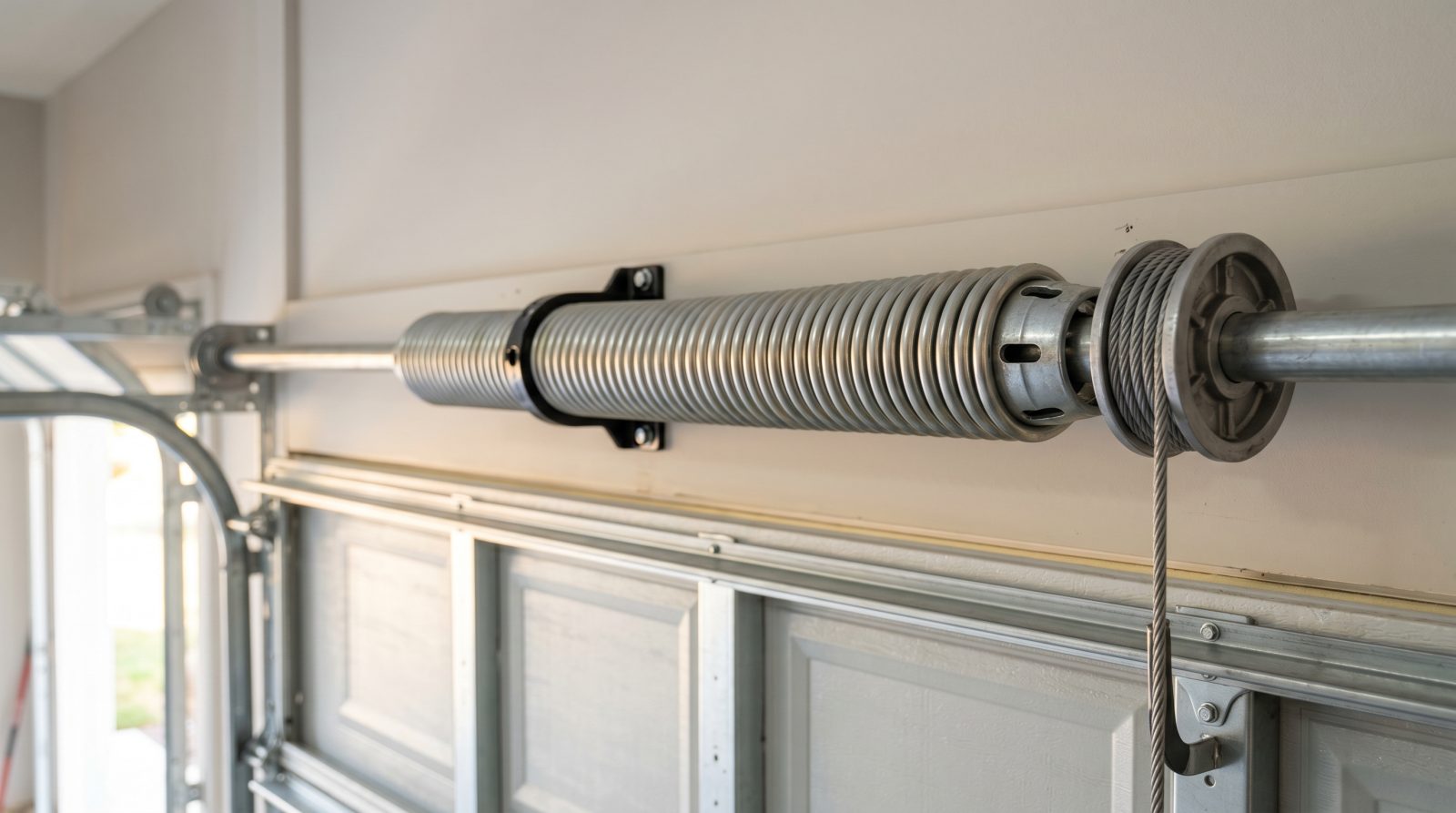
Torsion springs are the heavy, tightly wound coils mounted on a metal shaft above the door opening. As the door lowers, cables wind the spring tighter, storing energy; as the door rises, that stored energy unwinds to do the lifting. Torsion systems are the modern standard because they're more controlled, last longer, and fail more predictably. Extension springs are the long, stretched springs that run parallel to the horizontal tracks on either side of the door. They store energy by stretching rather than twisting and are common on older Sacramento homes and lighter single-car doors.
Both systems are under enormous, constant tension, even when the door is sitting still. That stored energy is exactly what makes a spring useful, and exactly what makes a failed spring dangerous to handle. When our technician arrives, the first thing we identify is which system you have, its measured wire size, inside diameter, and length, because matching those specifications is what determines whether the repaired door is properly balanced and safe.
- Torsion springs: mounted on a shaft above the door, wind and unwind to lift; the durable modern standard.
- Extension springs: stretch along the horizontal tracks; common on older and lighter doors.
- The springs, not the opener motor, carry the weight of the door.
- Correct repair depends on matching wire size, inside diameter, length, and wind direction exactly.
Why Garage Door Springs Break
Springs don't fail randomly; they wear out on a measurable cycle count. A standard spring is rated for roughly 10,000 cycles, where one cycle is the door going up and back down once. For a busy Sacramento household that uses the garage as the main entrance, multiple trips a day add up fast, and that 10,000-cycle rating can be reached in just a handful of years. This is why a spring that seemed perfectly fine suddenly snaps: it simply reached the end of its engineered fatigue life. The good news is that higher-cycle springs are available, and we can often install a longer-life spring sized to how much you actually use the door.
Our local climate plays a real role too. Sacramento summers routinely push past 100 degrees, and an uninsulated garage can get brutally hot, while winter mornings in the valley bring cold, damp, foggy conditions. That repeated swing between hot, dry summers and cool, humid winters stresses the metal and accelerates fatigue. Humidity and the occasional damp spell can also encourage rust on the coils, and a rusty spring grinds against itself with every cycle, wearing out far sooner than a clean, lubricated one.
Other common culprits include simple lack of maintenance, springs are one of the few car-sized mechanical systems most homeowners never touch, plus improper original installation, an undersized or mismatched spring, or a door that's out of balance forcing the spring to work harder than it should. When one spring on a two-spring torsion system breaks, we generally recommend replacing both at the same time. They've endured nearly identical wear, so a second break is usually close behind, and replacing the pair restores even balance and saves you a second service visit.
- Metal fatigue: most springs are rated around 10,000 cycles and wear out on a predictable timeline.
- Sacramento's heat-to-damp seasonal swing stresses the steel and speeds up fatigue.
- Rust from humidity makes coils grind and shortens spring life.
- Mismatched, undersized, or poorly installed springs fail early.
- On dual-spring doors, replacing both at once prevents a repeat breakdown.
Why Spring Repair Is Not a Safe DIY Job
Of every repair on a garage door, spring replacement is the one we most strongly urge homeowners not to attempt themselves, and we say that knowing it costs us nothing to be honest about it. A wound torsion spring holds a tremendous amount of stored energy. If it's released without the correct winding bars and technique, it can unwind violently in a fraction of a second. Serious hand, wrist, head, and eye injuries from spring work are well documented, and they happen to confident, handy people, not just beginners.
The hardware compounds the danger. Many homeowners try to substitute screwdrivers, rebar, or sockets for proper winding bars, and the wrong tool slipping under load is exactly how injuries occur. Beyond the immediate hazard, getting the job slightly wrong, an incorrect spring size, the wrong wind direction, uneven tension between two springs, leaves the door out of balance. An unbalanced door drifts, slams, overworks the opener, and puts strain on the cables and rollers, quietly setting up the next failure.
There's also the matter of doing it right the first time. A professional repair isn't only swapping a part; it's measuring the door, selecting a correctly specified spring, setting precise tension, and then re-balancing and safety-testing the whole system. Our mobile technicians carry the winding bars, the spring inventory, and the experience to do this safely in your driveway. If you have a broken spring, the safest immediate step is to stop using the door and avoid forcing it open with the opener, which can cause further damage, then request a visit.
- A wound torsion spring stores enough energy to cause severe injury if released incorrectly.
- Makeshift tools slipping under load are a leading cause of garage door injuries.
- Wrong spring size or tension leaves the door unbalanced and damages the opener, cables, and rollers.
- If a spring breaks, stop operating the door and don't force the opener; book a professional visit.
How Our Mobile Spring Repair Works
Because we're a mobile, we-come-to-you operation, the entire repair happens at your home, there's nothing to haul anywhere and no waiting for a shop to open. When our technician arrives, we start with a full inspection: identifying your spring type, measuring its exact specifications, and checking the cables, drums, rollers, hinges, and tracks that work alongside the spring. A snapped spring is sometimes the headline, but a frayed cable or worn bearing can be part of the same story, and we'll show you what we find so nothing is a surprise.
Next we install the correctly sized replacement spring, or pair of springs, set the precise tension by hand with proper winding bars, and reconnect and adjust the cables. From there we balance the door, which is the step that separates a quick swap from a lasting repair. A balanced door, when disconnected from the opener, should hold its position about halfway up rather than dropping or flying open. We test that balance, run the door through several full cycles, confirm the opener's safety reverse is working, and lubricate the moving parts so the new spring runs smoothly.
We serve homeowners across the greater Sacramento area, from the older bungalows of East Sacramento and Curtis Park, where extension-spring doors are common, to the newer subdivisions in Elk Grove, Roseville, Rocklin, and Folsom that typically run torsion systems. Same-day spring repair is often available, and because the parts ride with us, most jobs are completed in a single visit. When you're ready, you can call or request a free quote and we'll get a technician headed your way.
- Full on-site inspection of springs, cables, drums, rollers, and tracks before any work begins.
- Correctly specified spring installed with proper winding bars and precise, hand-set tension.
- Door re-balanced and cycle-tested so the opener isn't carrying the load.
- Opener safety reverse checked and moving parts lubricated before we leave.
- Same-day service often available across Sacramento, Elk Grove, Roseville, Folsom, and nearby communities.
Signs Your Spring Is Failing, Or Already Broken
A broken spring rarely happens silently. The most unmistakable sign is a loud bang from the garage, often described as a firecracker or gunshot, that's the spring snapping under tension. After that, the symptoms are easy to recognize: the door feels suddenly, alarmingly heavy, the opener strains, hums, or lifts the door only a few inches before stopping, or the door won't move at all. On a torsion shaft you may even see a visible gap in the coil where the spring separated.
Some failures give you warning before the full break. A door that has become jerky, that opens crooked or hangs lower on one side, or that's noticeably noisier than it used to be can all point to a spring losing its strength or a cable starting to slip. Catching these early is worth doing, because a partially failing spring puts extra strain on every other component and on the opener. Acting at the first sign often means a simpler, cleaner repair.
Whatever the symptom, the safest response is the same: stop trying to operate the door. Repeatedly hitting the opener button on a door with a broken spring can burn out the motor, bend tracks, or damage the cables, turning a straightforward spring job into a larger repair. Leave the door where it is and reach out, our mobile technicians will diagnose it in your driveway and get you moving again.
- A loud bang or gunshot-like sound from the garage is the classic broken-spring signal.
- The door feels very heavy, won't open, or the opener strains and stalls part way.
- A visible gap in the torsion coil confirms a snapped spring.
- Crooked, jerky, or unusually noisy operation can warn of a spring about to fail.
- Stop using the door to avoid damaging the opener, tracks, and cables.