What Photo-Eye Safety Sensors Actually Do
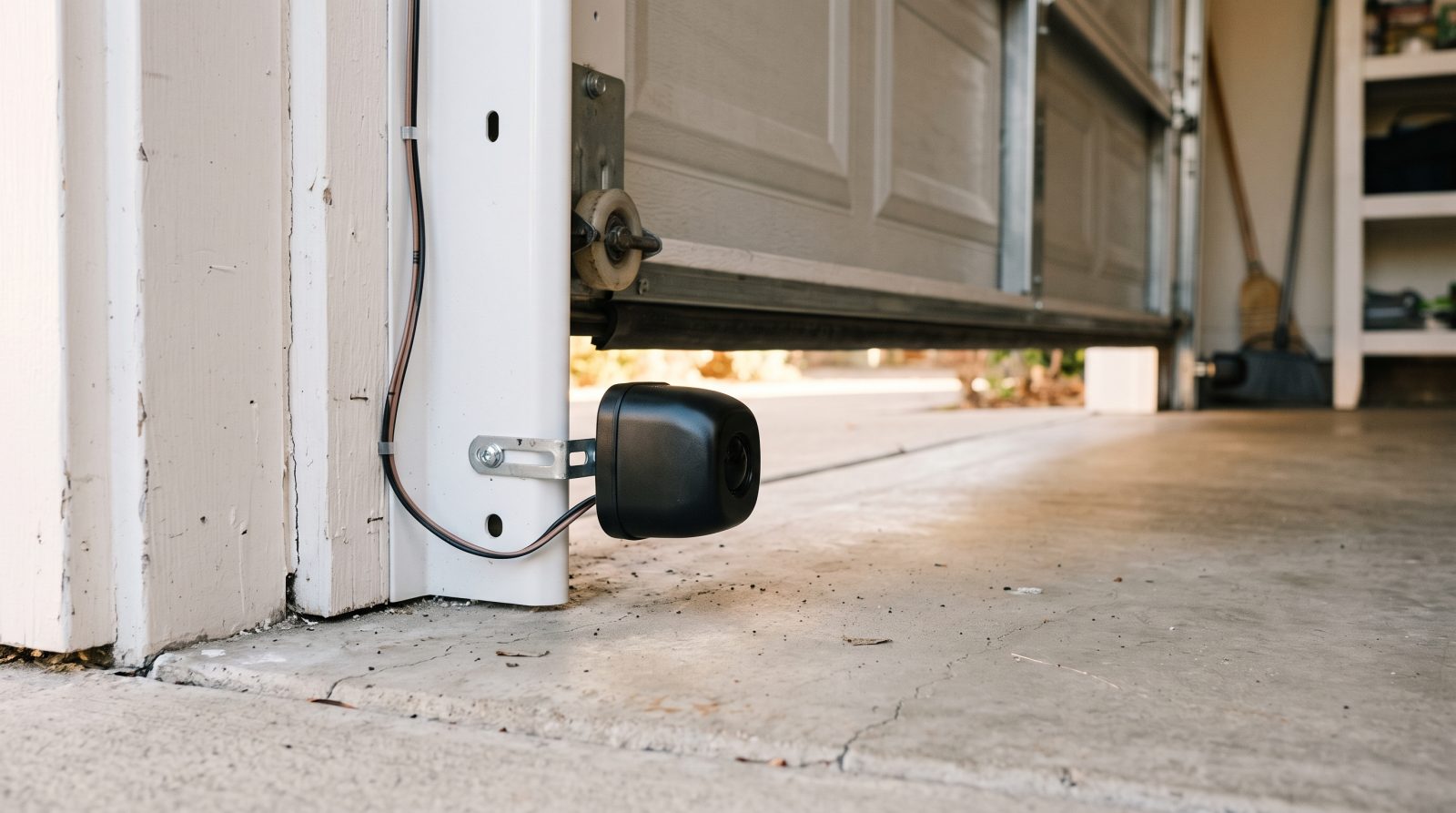
Every automatic garage door installed in the United States since 1993 is required by federal law to have a secondary entrapment-protection system, and on residential doors that almost always means photo-eye sensors. The U.S. Consumer Product Safety Commission pushed for this rule after a string of injuries and deaths from doors closing on children. The two sensors form an invisible infrared beam stretched across the bottom of the door opening, roughly four to six inches above the floor. One unit transmits the beam; the other receives it. As long as the receiver "sees" the beam, the opener is allowed to close the door.
The moment something breaks that beam — a child darting under the door, a trash can, a bike tire, even a thick shadow in some older units — the opener stops the door and sends it back up. This is non-negotiable safety behavior, not a glitch. It is also why a door that suddenly refuses to close is far more often a sensor problem than a motor or spring problem. The opener is usually working perfectly; it just won't risk closing on something it can't confirm is clear.
It helps to think of the sensors as the door's eyes and the wall button or remote as its hands. You can tell the door to close all day long, but if its eyes are covered, confused, or pointed the wrong way, it will refuse — and on most openers it will flash the lights or click to tell you so.
- Required by federal law on automatic residential doors since 1993, driven by CPSC entrapment-injury data
- One sensor sends an infrared beam, the other receives it; a broken beam forces the door to reverse
- Mounted low (about 4–6 inches off the floor) so they catch a child, pet, or object before the door can trap it
- A door that won't close is usually a sensor issue, not a broken motor or spring
Why Sensors Drift Out of Alignment (and Why It Happens More Here)
Photo-eyes are held in place by small metal brackets bolted to the vertical tracks near the floor. Those brackets are deliberately lightweight so they bend rather than snap if bumped — which means it doesn't take much to knock a sensor off its aim. A bicycle leaning against the track, a broom that slides down the wall, a bin shoved into the corner, a kid's scooter, even a strong vacuum hose can nudge an eye a few degrees. A few degrees is all it takes; the receiver loses the beam and the door stops cooperating.
Sacramento garages add a few local twists. Many homes here use the garage as the real front door and a catch-all for outdoor gear, so the area around the tracks gets crowded and bumped constantly. Our long, dry, dusty stretches from late spring through fall — especially when the Delta breeze and valley winds blow fine dust and pollen in under the door — coat the little lenses with a film that weakens the beam without anything physically moving. Then summer hits: an uninsulated Sacramento garage can push past 110°F, and that heat cycling expands and contracts the brackets and loosens screws over time. Add the occasional spider that loves to spin a web right across a warm sensor lens, and you have a recipe for a door that works fine in the morning and acts up by afternoon.
There is also wiring to consider. The thin bell wire running from each sensor up to the motor unit is often stapled along the wall and can get nicked by a nail, chewed by rodents, or pinched when something heavy is stacked against it. A damaged wire produces the same symptom as a misaligned eye, so it is worth a glance during your own inspection.
- Lightweight brackets bend easily when bumped by bikes, bins, brooms, or tools stored near the tracks
- Sacramento dust, pollen, and Delta-breeze grit film over the lenses and weaken the beam
- Summer garage heat (often 110°F-plus in uninsulated spaces) loosens screws and shifts brackets over time
- Spider webs across a lens and nicked or chewed sensor wiring cause the same symptoms as misalignment
How to Read the LED Lights and Diagnose the Problem
Nearly every photo-eye has a small indicator LED, and learning to read it turns a frustrating guessing game into a thirty-second diagnosis. Conventions vary by brand, so check your opener's manual, but the most common setup works like this: the sending sensor shows one steady light to confirm it has power, and the receiving sensor shows a steady light only when it is properly aimed and "seeing" the beam. If the receiving sensor's light is off, flickering, or blinking, the beam is blocked or the two eyes are not pointed at each other.
Start with the simplest causes and work up. First, look for anything physically in the beam's path, including small items on the floor you might overlook. Second, gently wipe both lenses with a soft, dry cloth or a slightly damp one — never a harsh cleaner — to clear dust, pollen, and webs. Third, sight down the line between the two sensors to see if one is visibly cocked up, down, or sideways compared to the other. If the receiving LED is completely dark even after cleaning, suspect power or wiring rather than aim; check that the wires are seated and undamaged.
A clean test for alignment: with the door open, slowly nudge the receiving sensor by hand while watching its LED. When it locks onto the beam, the light snaps to steady. Tighten the wing nut or screw on the bracket at that exact spot. Then test the door from the wall button (stay clear of the doorway) and watch that it closes smoothly without reversing. If the door now closes but you want to be sure the safety still works, wave a broom handle through the beam mid-close — the door should immediately stop and reverse. If it doesn't, stop using the opener and get it looked at, because that is the one function that absolutely must work.
- A steady receiver LED means the beam is aligned; off or blinking means blocked, misaligned, or no power
- Work simplest-first: clear the path, wipe the lenses, then check the aim, then check the wiring
- Nudge the receiver by hand until its LED snaps steady, then tighten the bracket at that spot
- Always confirm the safety reverse afterward by breaking the beam with a broom handle during a close
What You Can Safely Fix Yourself vs. When to Call a Pro
The good news is that the most common sensor problems are genuinely homeowner-friendly. Cleaning the lenses, removing an obstruction, sweeping away a web, and re-aiming a bumped sensor by hand are all safe, no-tools-or-one-screwdriver jobs that involve zero high-tension parts. If your door started misbehaving right after someone bumped the track or after a dusty week, try these first — there is a real chance you fix it in a few minutes and never need us at all. We would rather you save the money than pay for something you could clear with a soft cloth.
Where you should stop is anywhere the problem moves past the sensors themselves. If the LEDs look correct and the path is clear but the door still reverses, slams, or won't move, the issue may be in the travel and force settings on the motor unit, the logic board, or — most importantly — the springs and cables. Garage door torsion and extension springs hold enormous stored energy; a failing spring or frayed cable can release with enough force to cause serious injury, and these are never DIY territory. Likewise, replacing a dead sensor, repairing chewed wiring inside the wall, or recalibrating an opener is work for someone who does it every day.
This is where being a mobile service matters for Sacramento homeowners. You should not be wrestling a heavy, possibly unbalanced door, and you definitely should not drive anywhere with a garage problem — we bring the tools and parts to your driveway, whether you're in Land Park, Natomas, Elk Grove, Folsom, Roseville, Citrus Heights, or anywhere across the metro. We can test the sensors and the full safety system, check the springs and cables you should never touch, and confirm the door reverses the way the law requires before we leave. If your own checks didn't solve it, that's exactly the line where a call makes sense — request a free quote and we'll come to you, same-day when we can.
- Safe DIY: clearing the path, wiping lenses, removing webs, and re-aiming a bumped sensor by hand
- Call a pro: persistent reversing after the sensors check out, dead sensors, in-wall wiring, or opener recalibration
- Never DIY: springs and cables — they store enough force to cause serious injury
- Mobile service across Sacramento, Elk Grove, Folsom, Roseville, Natomas and nearby — we come to you, same-day when available