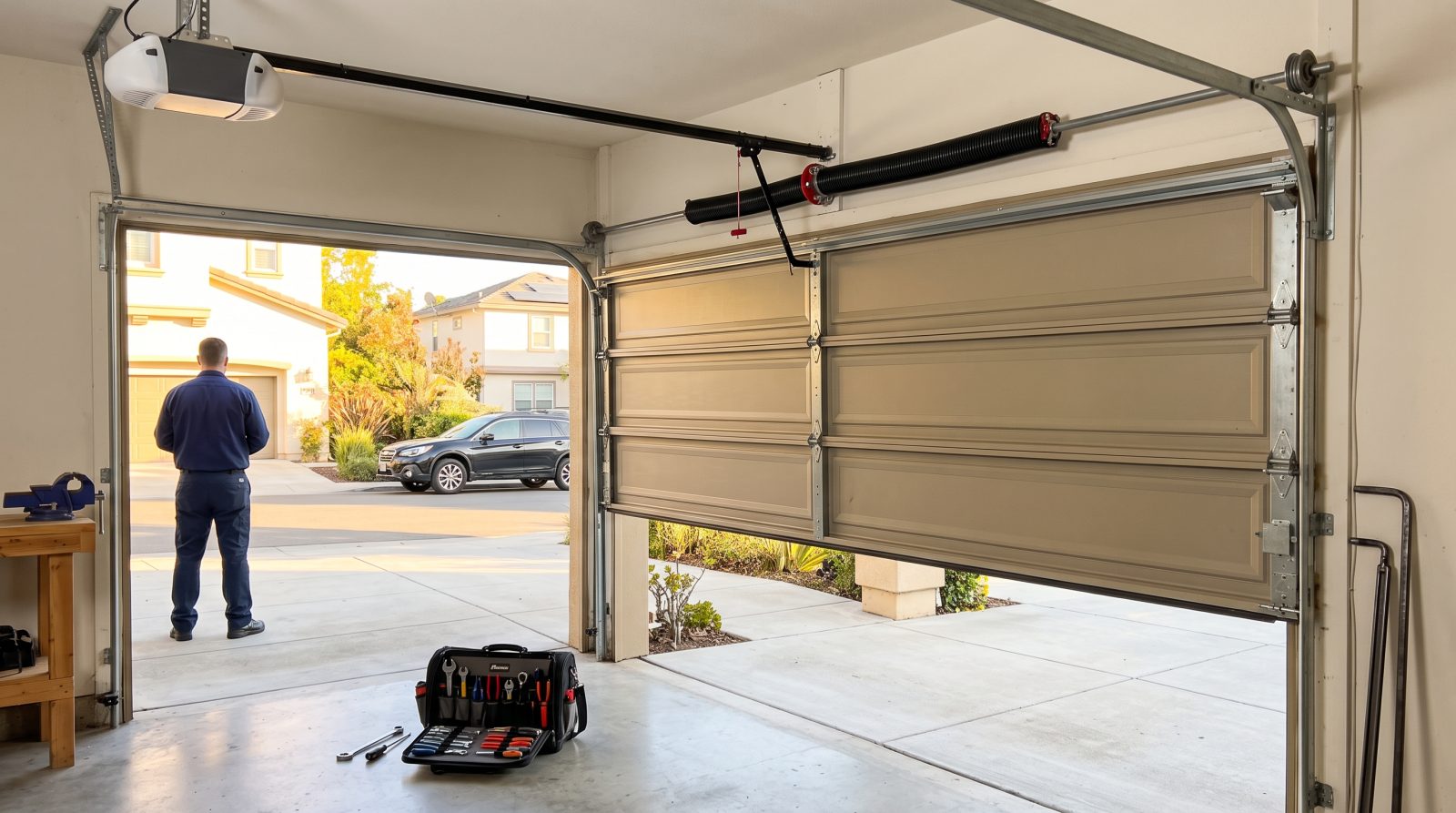
Mobile Garage Door Repair, Brought to Your Driveway
Everything we do happens at your home. Our trucks roll out stocked with the springs, rollers, cables, hinges, opener parts, and hardware that fix the overwhelming majority of garage door problems in one visit, so you're not left with a half-open door waiting on a follow-up. We work in driveways from Land Park to Natomas, Elk Grove to Citrus Heights, Folsom to West Sacramento, and the neighborhoods in between.
Being mobile is a genuine advantage with garage doors. A residential door and its hardware are heavy, awkward, and under serious spring tension; they are not something to detach and transport. Diagnosing the real cause also means watching the door run on its own tracks, against its own opener, in its own opening, where the weather, the slab, and decades of settling all play a part. We'd rather see your actual door than guess from a photo.
When you reach out, we'll ask a few quick questions about what the door is doing, get a sense of the age and style of the system, and schedule a visit. In most cases we can offer same-day or next-day service. You'll get a clear explanation of what's wrong and a labeled price range before any work starts, so there are no surprises when the job is done.
- Fully mobile across the Sacramento area: we come to you, no storefront visit needed
- Trucks stocked for common springs, rollers, cables, openers, and hardware
- On-site diagnosis on your real door, not a guess from a description
- Same-day service whenever scheduling allows, with clear pricing up front
The Garage Door Problems We Fix Most in Sacramento
Garage doors fail in a handful of predictable ways, and the right repair depends on correctly identifying which part has gone. Below are the issues we're called out for most often around Sacramento, along with what's usually behind them. If your symptom isn't listed, it almost certainly still falls into one of these systems, and a quick on-site look will pin it down.
A broken torsion spring is the single most common emergency we see. Springs are wound under high tension and store the energy that lifts a door that can weigh well over a hundred pounds; when one breaks you'll often hear a loud bang, and afterward the door feels impossibly heavy or won't budge with the opener. Sacramento's wide temperature swings, from triple-digit summer afternoons to damp, cool winter mornings, are hard on spring steel and accelerate metal fatigue over thousands of cycles.
Off-track and cable problems are the other big category. A door can jump its track after a car bumps it, a roller wears out, or a lift cable frays and snaps, leaving the door crooked, jammed, or hanging at an angle. This is a situation to stop using the door entirely until it's looked at, because a partially off-track door under spring tension can fall. Opener trouble rounds out the list: dead logic boards, worn gears, misaligned safety sensors, faded remotes, and units simply old enough to retire.
- Broken or worn torsion and extension springs (the most common emergency)
- Doors off their tracks, bent tracks, and frayed or snapped lift cables
- Openers that won't run: dead motors, stripped gears, bad logic boards
- Safety sensors out of alignment, so the door reverses or won't close
- Worn rollers and hinges causing grinding, squealing, or shaky travel
- Cracked, dented, or sagging panels and sections after impact or age
- Doors that open or close on their own, or stop partway and reverse
Why Sacramento's Climate and Homes Are Hard on Garage Doors
Garage doors wear differently depending on where they live, and the Sacramento Valley puts a specific kind of stress on them. Our long, intense summers regularly push past 100 degrees, and an attached garage with a metal door can turn into an oven. That heat bakes the grease out of rollers and bearings, expands metal components, and dries out the lubrication that keeps springs and hinges moving smoothly. Then winter swings the other way, with damp mornings, tule fog, and the cool Delta breeze that introduce moisture and encourage rust on hardware and cables.
The housing stock matters too. Sacramento has a wide mix, from the older bungalows and vintage homes of Land Park, Curtis Park, East Sacramento, and Oak Park, where original or aging doors and decades-old openers are common, to the sprawling newer subdivisions in Natomas, Elk Grove, Folsom, Roseville, and Rancho Cordova, where doors get cycled constantly because the garage is the everyday entrance. High-cycle use in a busy household simply wears springs and rollers out faster.
None of this is a reason to replace a whole door on a whim. It is a reason to keep an eye on the parts that take the abuse and to fix small issues before they cascade. A dry, squealing roller is cheap to swap; ignored, it can throw a door off-track and chew up a track. Catching the early warning signs is where most of the savings live.
- Triple-digit summer heat dries out lubrication and stresses spring steel
- Damp winters, fog, and the Delta breeze invite rust on cables and hardware
- Older central-city homes often run aging doors and dated openers
- Suburban garages used as the main entry rack up cycles and wear faster
How a Mobile Repair Visit Works
We try to make the visit simple and transparent from the first call to the moment your door runs like it should again. The goal is for you to understand what's wrong, what the fix costs, and why, before we touch anything.
After you describe the symptom, we schedule a visit and arrive at your home with a stocked truck. We start by testing the door through its full travel, checking the springs, cables, tracks, rollers, opener, and safety sensors, and finding the true cause rather than just the symptom. Then we walk you through what we found and give you a labeled price range for the repair. With your go-ahead, we complete the work on-site, balance and test the door several times, and make sure the opener and auto-reverse safety feature are working correctly before we leave.
We can also handle preventive tune-ups: lubricating moving parts, tightening hardware, adjusting spring balance and opener force, and checking cables and rollers for wear. For doors getting heavy daily use, or for older systems in our central neighborhoods, a periodic tune-up is one of the most cost-effective ways to head off a breakdown.
- Tell us the symptom; we schedule and arrive in a stocked mobile truck
- Full on-site inspection of springs, cables, tracks, rollers, opener, and sensors
- A clear explanation and a labeled price range before any work begins
- Repair completed on-site, then the door is balanced and safety-tested
- Optional tune-ups to extend the life of doors under heavy or aging use
What Garage Door Repairs Typically Cost
Honest pricing starts with honest expectations, so here's how to think about cost. Every door is a little different, and the only accurate number comes after we see yours, but garage door repairs fall into general industry ranges that help you plan. The figures below are typical ranges for the work itself and can shift with the type of door, the grade of parts chosen, and how many components need attention.
Spring replacement and cable work tend to sit in the lower-to-middle range and are usually a same-visit fix, with most jobs in the low-to-mid hundreds of dollars depending on the spring system and whether you replace in pairs (often the smart move, since a matched pair wears at the same rate). Roller, hinge, and sensor work is generally on the more affordable end. Opener repairs vary widely: a sensor realignment or a remote is minor, while a failed motor or logic board pushes toward the cost of a new opener, at which point replacing the unit can be the better value.
We'll always tell you when a repair is the right call and when replacing a part or the opener makes more financial sense, and we'll lay out the range before you decide. There's no obligation, and the explanation is part of the visit, not an extra.
- Spring and cable repairs: typically low-to-mid hundreds, usually same-visit
- Rollers, hinges, and sensor alignment: generally on the lower-cost end
- Opener fixes: minor for sensors and remotes, larger for motors or boards
- Ranges shift with door type, parts grade, and number of failed components
- We flag when replacing beats repairing, and quote a range before you commit